Dieser Artikel wurde ursprünglich auf Englisch veröffentlicht.
Interne und externe Innovation: können beide zusammenwirken?
Entdecken Sie, wie interne und externe Innovationsquellen die Geschäftspraxis und -ergebnisse beeinflussen.


In Innovationskreisen wird immer wieder diskutiert: Sollten Unternehmen ihre Innovationskraft vor allem aus dem Inneren schöpfen – oder gezielt Impulse von außen nutzen?
Die einen sagen: Stärkt, was in eurem Unternehmen bereits vorhanden ist.
Die anderen sind überzeugt: Die besten Ideen entstehen außerhalb der eigenen Organisation.
Wenn Sie noch zwischen diesen Ansätzen abwägen, lohnt sich ein genauer Blick auf ihre Auswirkungen. Denn erst wenn klar ist, was interne und externe Innovationsquellen tatsächlich bewirken, lässt sich eine Innovationsstrategie entwickeln, die zu Ihren Zielen, Ihrer Unternehmenskultur und der Dynamik Ihres Marktes passt.
Die wichtigsten Erkenntnisse auf einen Blick
Interne Innovation schafft nachhaltigen Wert, wenn sie in Menschen und Kultur verankert ist
Wenn Innovation aus der Organisation selbst entsteht – getragen von Mitarbeitenden, Führungskräften und bestehenden Strukturen – ist sie meist strategisch besser verankert, praxisnäher und langfristig tragfähig.Externe Innovation erweitert die Perspektive, Geschwindigkeit und disruptives Potenzial
Durch die Zusammenarbeit mit Kunden und Kundinnen, Start-ups, Partnern und Partnerinnen und Forschungseinrichtungen gewinnen Unternehmen neue Perspektiven und Einblicke in neue Trends und Ideen. Das hilft Organisationen, schneller zu agieren, agil zu bleiben und Veränderungen frühzeitig zu antizipieren.Die stärksten Innovationsstrategien kombinieren beides
Wer sich ausschließlich auf interne oder externe Quellen verlässt, geht Risiken ein. Nachhaltiger Erfolg entsteht dort, wo interne Innovationskraft gezielt mit externen Impulsen verbunden wird.rready unterstützt Unternehmen dabei, genau diese Balance zu schaffen
Mit den Lösungen von rready, einschließlich Idea Management, erfassen und strukturieren Organisationen Ideen aus der gesamten Belegschaft. Mit dem KICKBOX-Intrapreneurship-Programm können Intrapreneure diese Ideen auf bewährte Weise validieren und umsetzen. So entsteht aus Inspiration echte, skalierbare Innovationsfähigkeit.
Interne Innovationsquellen: Warum sie so wirkungsvoll sind
Interne Innovation basiert auf dem Wissen, der Erfahrung und dem Engagement der eigenen Mitarbeitenden. Typische Quellen sind:
Quelle | Beschreibung | Rolle | Wichtigkeit |
Führungskräfte und Innovationsverantwortliche | Führungskräfte, Innovationsausschüsse oder Rollen wie Chief Innovation Officer | Bestimmt Richtung, Vision und Ambition für Innovation | Schafft Ausrichtung, Tempo und einen sicheren Raum für Innovation |
Zentrale F&E Einheiten | Unternehmensweite F&E-Einheiten, die zentral finanziert und verwaltet werden | Treibt angrenzende und transformative Innovationen | Ermöglicht langfristige Forschung und disruptive Entwicklung |
Dezentrale F&E Einheiten | F&E-Einheiten, die in einzelnen Geschäftsfeldern eingebettet sind | Bedient marktspezifische und produktspezifische Innovationsbedürfnisse | Erhöht Relevanz, Geschwindigkeit und Kundenausrichtung |
Intrapreneure | Mitarbeitende, die Innovationsprojekte innerhalb der Organisation leiten | Verwandelt individuelle Initiative in skalierbare Innovation | Entfesselt unternehmerische Energie, ohne das Unternehmen zu verlassen |
Die gesamte Belegschaft | Die breitere Belegschaft bringt Ideen und Einsichten ein | Ermöglicht kontinuierliche Ideengenerierung und Kontinuierliche Verbesserung | Zapft Frontline-Wissen und kollektive Intelligenz an |
Interne Innovationsquellen: 7 zentrale Auswirkungen
Interne Innovationsquellen bestimmen, wie Unternehmen Ideen mit Strategie in Einklang bringen, langfristige Fähigkeiten aufbauen und Innovation in die Praxis umsetzen.
Die sieben folgenden Effekte zeigen, welche Auswirkungen interne Innovationsquellen auf die Innovation haben.
1. Sie richten Innovation an realen Geschäftsanforderungen aus
Mitarbeitende kennen sowohl Kundenprobleme als auch strategische Prioritäten und interne Rahmenbedingungen. Dadurch entstehen Lösungen, die zur Organisation passen und realistisch umsetzbar sind.
2. Sie schaffen Wettbewerbsvorteile, die schwer kopierbar sind
Interne Innovation basiert auf implizitem Wissen, Erfahrung und Routinen eines Unternehmens.
Dieses Wissen ist für Außenstehende schwer zugänglich – und damit auch die daraus entstehenden Innovationen.
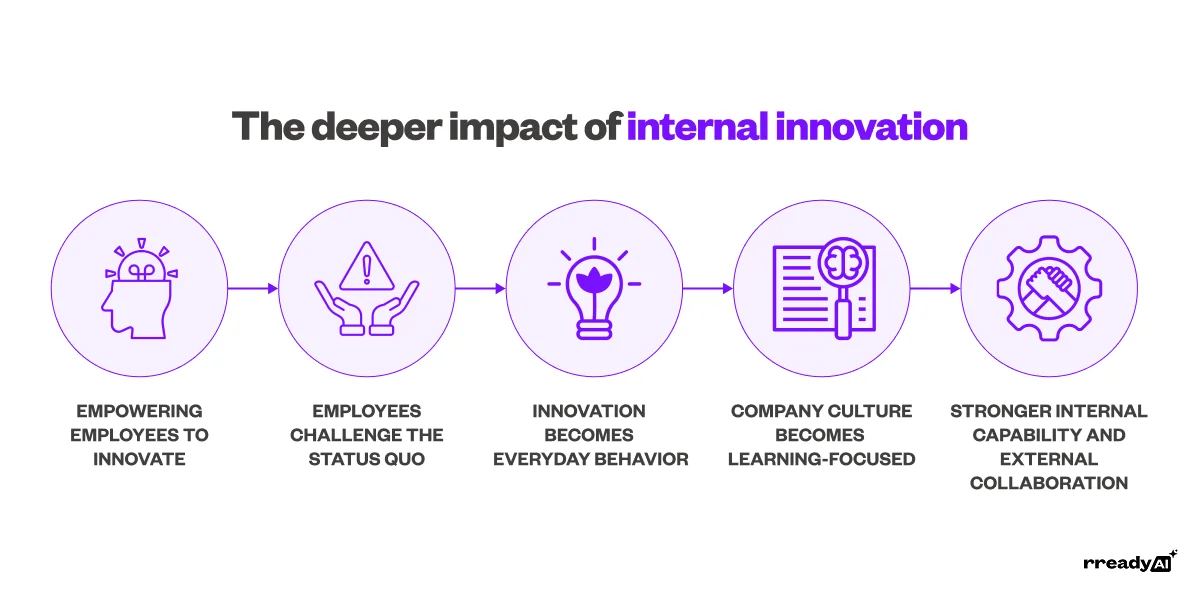
3. Sie verankern Innovation in der Unternehmenskultur
Wenn Mitarbeitende aktiv zur Innovation beitragen, wird sie Teil des Arbeitsalltags. Das stärkt Engagement, Verantwortungsgefühl und eine Kultur in der Lernen wichtig ist.
Im Laufe der Zeit stärkt dieser kulturelle Wandel die internen Fähigkeiten, die Unternehmen benötigen, um erfolgreich mit externen Partnern zusammenzuarbeiten und Innovation nachhaltig – über einzelne Initiativen hinaus – zu verankern. Denn Mitarbeitende gewöhnen sich daran, zu experimentieren, Ideen zu teilen und aus Fehlern zu lernen. Dadurch sind sie besser in der Lage, externe Impulse aufzunehmen, partnerschaftlich zu arbeiten und neues Wissen wirksam in die Praxis umzusetzen.
4. Sie schützen geistiges Eigentum und sensibles Know-how
Interne Innovationsprozesse reduzieren das Risiko, kritische Informationen nach außen zu geben, und sichern langfristige Differenzierung.
Dadurch behalten Unternehmen die Kontrolle über zentrale Kompetenzen, reduzieren ihre Abhängigkeit von externen Partnern und schützen gezielt jene einzigartigen Ressourcen, die langfristige Differenzierung und nachhaltige Wettbewerbsvorteile ermöglichen, wie zum Beispiel:
Proprietäre Prozesse
Spezialisiertes Know-how
intern entwickelte Technologien
5. Sie ermöglichen kontinuierliche Verbesserung
Viele interne Innovationen sind inkrementell. Kleine, stetige Verbesserungen und Erweiterungen von Produkten, Dienstleistungen und Prozessen summieren sich über Zeit zu spürbaren Leistungssteigerungen.
Auf lange Sicht schafft dies wiederholbare Innovationsgewohnheiten, macht Prozesse robuster und ermöglicht der Organisation, komplexere Innovationsherausforderungen zu bewältigen.
6. Sie verbessern Prozesse und Arbeitsweisen
Wenn Menschen an Innovation denken, kommen ihnen meist neue Produkte, Dienstleistungen oder Technologien in den Sinn.
Doch es gibt eine weitere Form, die ebenso wirkungsvoll ist: die Prozessinnovation.
Interne Innovationsquellen sind hier besonders effektiv, weil Mitarbeitende Ineffizienzen unmittelbar erleben. Diese Nähe zum Arbeitsalltag erleichtert es, Engpässe zu erkennen und Prozesse entlang der tatsächlichen Abläufe neu zu gestalten.
Die Vorteile zeigen sich in:
effizienteren Abläufen entlang von Produktion und Leistungserbringung über Produktion und Lieferung hinweg
höherer Zuverlässigkeit im täglichen Betrieb
messbaren Leistungssteigerungen, die langfristig nachhaltiges Wachstum unterstützen
7. Höhere Erfolgswahrscheinlichkeit
Interne Innovation stärkt die Innovationsleistung, indem sie die erfolgreiche Umsetzung von Ideen begünstigt.
Teams, die innerhalb vertrauter Systeme, Tools und organisatorischer Rahmenbedingungen arbeiten, können Ideen gezielter testen, weiterentwickeln und skalieren. Sie kennen die internen Abläufe, Entscheidungswege und möglichen Hürden – und können entsprechend realistisch planen und handeln.
Das zeigt sich auch in der Praxis: Studien belegen, dass 87% der intern entwickelten Ventures zu einem nachhaltigen Wettbewerbsvorteil führten, im Vergleich zu 60 % bei extern getriebenen Innovationsprojekten.
Für Unternehmen bedeutet das: stärkere Innovationsleistung und eine deutlich höhere Wahrscheinlichkeit, dass Innovationsinitiativen langfristig echten Mehrwert schaffen.
Externe Innovationsquellen: Was sie ermöglichen
Im Gegensatz zu internen Quellen, die auf den eigenen Mitarbeitenden und Kompetenzen eines Unternehmens aufbauen, eröffnen externe Innovationsquellen neue Perspektiven, Ideen und Expertise über die Unternehmensgrenzen hinaus.
Die folgende Übersicht zeigt die wichtigsten externen Innovationsquellen und ihren Beitrag zu Innovationsprozessen:
Quelle | Beschreibung | Rolle | Wichtigkeit |
Kunden | Nutzer und Nutzerinnen von Produkten oder Dienstleistungen | Liefern direkte Einblicke in Bedürfnisse, Pain Points und tatsächliche Nutzung | Verankern Innovation in realer Nachfrage und Marktbedürfnissen |
Crowdsourcing | Externe Personen, die Ideen im großen Umfang beitragen | Erweitern die Ideengenerierung über Organisationsgrenzen hinaus | Erschließen vielfältige Perspektiven und kollektive Kreativität |
Soziale Medien und Online-Communities | Digitale Plattformen für Meinungen, Trends und Diskussionen | Machen Echtzeit-Insights und neue Verhaltensweisen sichtbar | Ermöglichen schnelle Feedbackschleifen und Co-Creation |
Wettbewerber | Unternehmen im gleichen oder angrenzenden Markt | Zeigen Marktbewegungen, Lücken und strategische Entwicklungen auf | Unterstützen Benchmarking und Differenzierung |
Zulieferer | Anbieter von Materialien, Komponenten oder Services | Bringen neue Technologien, Materialien und Prozesse ein | Ermöglichen Effizienzsteigerungen und Produkt- oder Prozessinnovationen |
Software- und Beratungsunternehmen | Externe Experten und Expertinnen mit Tools, Plattformen und Beratungskompetenz | Unterstützen Innovationsprozesse, Analyse und Umsetzung | Beschleunigen Reifegrad und Kompetenzaufbau |
Start-ups | Junge, schnell wachsende Unternehmen | Bringen disruptive Ideen, Modelle und Technologien ein | Fördern Agilität und Experimentierfreude |
Forschungseinrichtungen | Akademische und wissenschaftliche Organisationen | Entwickeln neue Technologien und Forschungsergebnisse | Erweitern den Zugang zu tiefgehender Expertise und langfristiger Innovation |
Externe Innovationsquellen: 7 zentrale Auswirkungen
Externe Innovationsquellen beeinflussen maßgeblich, wie Unternehmen auf Veränderungen reagieren, neues Wissen erschließen und ihre Innovationsreichweite erweitern.
1. Sie bringen vielfältige Perspektiven und spezialisiertes Know-how ein
Externe Innovation bedeutet bewusst, über bestehendes Wissen hinauszublicken – jedoch nicht aus reiner Neugier, sondern mit strategischem Ziel.
Richtig ausgewählt, liefern externe Partner neue Denkansätze und spezialisiertes Fachwissen. Gerade im Kontext inklusiver Innovation hilft diese Vielfalt, Annahmen zu hinterfragen und blinde Flecken zu vermeiden.
Für Unternehmen führt das zu:
fundierteren Entscheidungen
robusteren Lösungen
Innovationen, die reale Marktbedürfnisse besser widerspiegeln
2. Sie ermöglichen das frühe Testen neuer Trends
In dynamischen Märkten kann es riskant sein, abzuwarten, bis sich Trends vollständig etabliert haben.
Externe Partner – etwa Start-ups oder Technologieanbieter – ermöglichen es, neue Technologien, Produkte oder Geschäftsmodelle frühzeitig zu testen. Teams können Entwicklungen praxisnah beobachten, Erkenntnisse intern teilen und Unsicherheiten reduzieren, bevor größere Investitionen erfolgen.
3. Sie schärfen Markt- und Wettbewerbsbewusstsein
Wer sich ausschließlich auf interne Perspektiven konzentriert, läuft Gefahr, externe Veränderungen zu übersehen.
Externe Quellen bringen eine Outside-in-Sichtweise ein und helfen, zentrale Faktoren besser zu verstehen, wie:
Marktveränderungen
Strategische Schritte von Wettbewerbern
Veränderte Kundenerwartungen
Diese Perspektive hinterfragt interne Annahmen und sorgt für realitätsnahe Entscheidungen.
4. Sie beschleunigen Innovation und Time-to-Market
Geschwindigkeit ist heute ein eigenständiger Wettbewerbsvorteil.
Der Zugang zu externem Wissen reduziert interne Entwicklungsengpässe, da Unternehmen auf bestehende Expertise und Ressourcen zurückgreifen können. Dadurch entstehen:
Schnellere Markteinführungen
Geringeres Risiko, Marktchancen zu verpassen
Bessere Nutzung kurzfristiger Trends
5. Sie erhöhen organisatorische Agilität
Schnelligkeit allein reicht nicht – ebenso wichtig ist Anpassungsfähigkeit.
Externe Partnerschaften schaffen Optionen statt langfristiger Bindungen. Unternehmen können neue Richtungen testen, ohne sich frühzeitig festzulegen oder hohe Entwicklungskosten zu riskieren.
Dieser agile Innovationsansatz erleichtert es, Initiativen zu pausieren oder zu skalieren, basierend auf dem, was funktioniert.
Das ermöglicht:
Geringeres Entscheidungsrisiko
Kürzere Lernzyklen
Schnellere Anpassung an Markt- und Technologieveränderungen
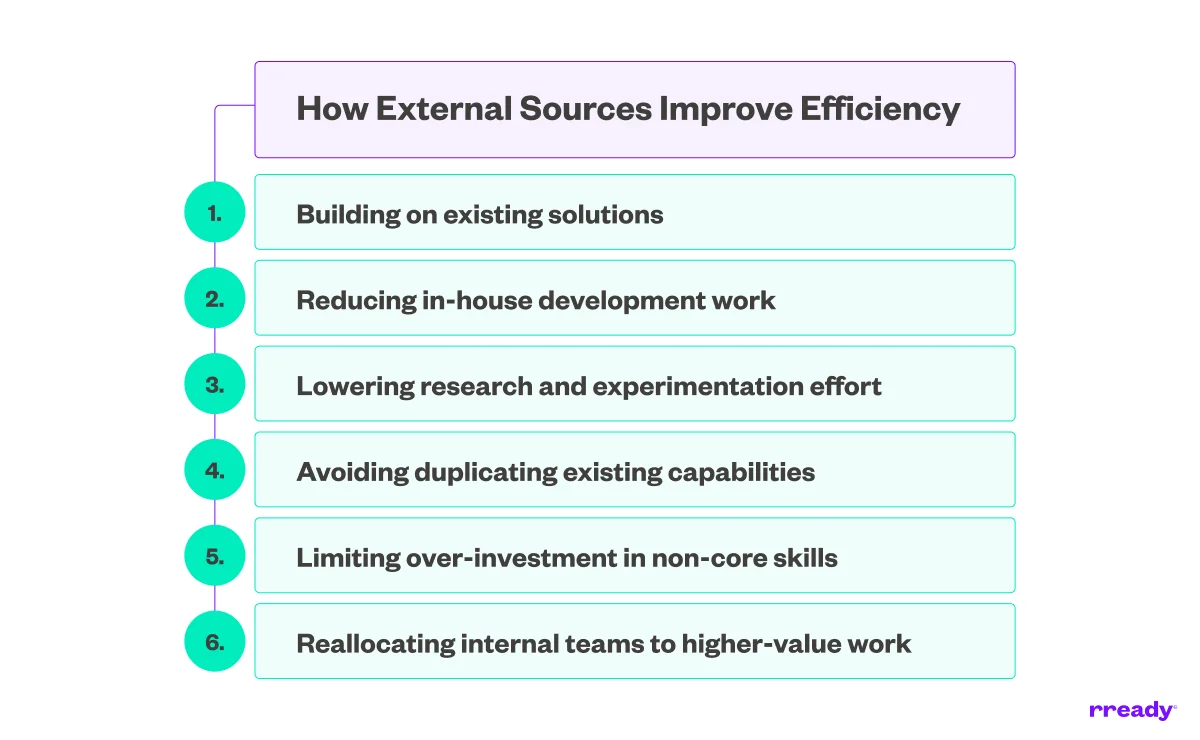
6. Sie steigern Effizienz durch geringeren Entwicklungsaufwand
Alles selbst zu entwickeln ist kosten- und ressourcenintensiv – nicht nur finanziell, sondern auch hinsichtlich Zeit und Opportunitätskosten.
Externe Innovationsquellen erlauben es, auf bestehenden Lösungen aufzubauen statt bei null zu beginnen. Das senkt Forschungs- und Entwicklungsausgaben und verhindert Überinvestitionen in Kompetenzen, die bereits extern verfügbar sind.
So werden Ressourcen für strategisch wichtigere interne Initiativen frei.
7. Sie eröffnen Potenzial für disruptive Innovation
Interne Innovation fokussiert sich häufig auf die Verbesserung bestehender Angebote. Externe Quellen hingegen bringen häufiger radikale Ideen, neue Technologien oder alternative Geschäftsmodelle ein.
Da sie außerhalb etablierter Strukturen entstehen, stellen sie grundlegende Annahmen infrage – und eröffnen die Chance, Wertschöpfung neu zu definieren.
Für Unternehmen erhöht das die Wahrscheinlichkeit, disruptive Entwicklungen frühzeitig zu erkennen und aktiv zu gestalten.
Die richtige Balance zwischen interner und externer Innovation
Interne und externe Innovationsquellen bringen jeweils eigene Stärken mit.
Die Herausforderung entsteht, wenn eine als Ersatz für die andere verstanden wird.
Ein starker Fokus auf externe Innovation kann Prozesse beschleunigen – doch ohne interne Innovationsfähigkeit bleibt der Effekt oft kurzfristig. Es entsteht Angleichung, aber kein nachhaltiger Wettbewerbsvorteil.
Deshalb ist Balance entscheidend.
rready unterstützt Unternehmen dabei, externe Impulse gezielt zu nutzen, um interne Innovationskraft nachhaltig zu stärken.
Statt Innovation auszulagern, befähigt rready Mitarbeitende, selbst zu aktiven Innovatoren zu werden – skalierbar und strukturiert.
Besonders wirkungsvoll sind dabei zwei Lösungen aus der rready Innovation Suite:
Mit der Ideenmanagement Lösung von rready können Unternehmen:
Ideen aus der gesamten Organisation erfassen
diese transparent und strukturiert bewerten
aus Alltagsbeobachtungen eine skalierbare Innovationspipeline entwickeln
Mit dem KICKBOX Intrapreneurship-Programm können Unternehmen Intrapreneure dazu befähigen:
Ideen mit echten Daten und Kundenfeedback zu validieren
schnell und niedrigschwellig zu experimentieren
innerhalb eines bewährten Rahmens zu lernen, zu iterieren und umzusetzen
Gemeinsam stärken diese Lösungen die interne Innovationsfähigkeit – sodass externe Impulse nicht nur Inspiration liefern, sondern langfristige Innovationskraft aufbauen.
Buchen Sie eine personalisierte Demo, und erfahren Sie, wie rready führende Unternehmen dabei unterstützt, interne Innovation zu skalieren, strategisch auszurichten und Ideen in messbare Ergebnisse zu überführen.

Mehr erfahren

8 Vorteile von Ideenmanagement-Software
Entdecken Sie die Vorteile von Ideenmanagement-Software: Ideen erfassen, Zusammenarbeit verbessern und Mitarbeiterideen in echten Geschäftserfolg umsetzen.

9 Methoden zur Ideenfindung für Unternehmen im Jahr 2026
Die besten Ideenfindungstechniken, um Kreativität zu fördern, Denken zu strukturieren und Ideen in umsetzbare Ergebnisse für Ihr Team zu verwandeln.

Finanzielle vs. nichtfinanzielle Anreize bei Innovationen
Erfahren Sie, wie finanzielle und nichtfinanzielle Anreize Innovation fördern und Mitarbeitende motivieren, Ideen einzubringen und engagiert zu bleiben.