Open Innovation vs. Closed Innovation: What's the Difference
Compare open innovation vs closed innovation to see which approach fits your goals, culture, and risk so you can build smarter, faster innovation.


As many as 83% of companies rank innovation among their top three priorities. However, recognizing the need to innovate and actually making innovation work are two very different challenges.
Turning innovation into real impact requires the right structure, the right mindset, and some very deliberate choices, one of the most important ones being how you want to innovate.
For many organizations, that decision comes down to open innovation vs. closed innovation: keeping innovation tightly in-house or opening the door to ideas, insights, and collaboration beyond the organization’s walls.
To make the right choice, you must first understand how these two approaches differ and what those differences mean for your business.
In this guide, you’ll find the crucial distinctions you need to know in order to decide which innovation model fits your goals, culture, and ambition.
Key takeaways
Open and closed innovation solve different problems
Both aim to create value, but they excel in different contexts. Open innovation works best for exploratory, uncertain challenges where knowledge is spread outside the organization. Closed innovation fits well-defined problems that require tight coordination and strong internal expertise.The real decision driver is where knowledge lives
If critical knowledge already sits inside your company, closed innovation makes sense. If valuable insights, technologies, or perspectives exist beyond your walls, open innovation prevents blind spots and unlocks broader opportunity.Open innovation increases reach and flexibility but demands stronger governance
It enables faster learning and greater adaptability. At the same time, it requires clear structures for control, confidentiality, quality, and collaboration to avoid chaos.Closed innovation offers control and consistency at a higher cost
Internal innovation provides tighter IP ownership, quality assurance, and alignment. The trade-off is higher R&D cost, longer cycles, and increased risk of isolation in fast-changing markets.You don’t have to commit fully to open or closed innovation
Many organizations succeed by combining internal execution with selective external input. Solutions like rready’s KICKBOX Intrapreneurship Program make this practical by equipping employees with external expertise and proven methods at the start, then enabling them to develop and execute ideas internally within a structured framework.
Open innovation vs. closed innovation: 13 key differences
Open and closed innovation aim for the same outcome: creating value through innovation.
However, they take different paths to reach this outcome, shaping everything from idea sourcing and collaboration to ownership and execution.
Here are 13 differences between open and closed innovation:
1. Source of ideas
The fundamental difference between open and closed innovation is where ideas come from.
Open innovation actively sources ideas beyond the organization’s boundaries, while still building on internal knowledge and capabilities. Ideas deriving from external sources are used to complement internal efforts, expanding the pool of possibilities and creating multiple paths for ideas to move forward.
Closed innovation, by contrast, relies entirely on internal idea generation. New concepts are created, developed, and evaluated using in-house knowledge, resources, and research and development (R&D).
2. Talent
Based on the two sources of ideas, talent differs between open and closed innovation.
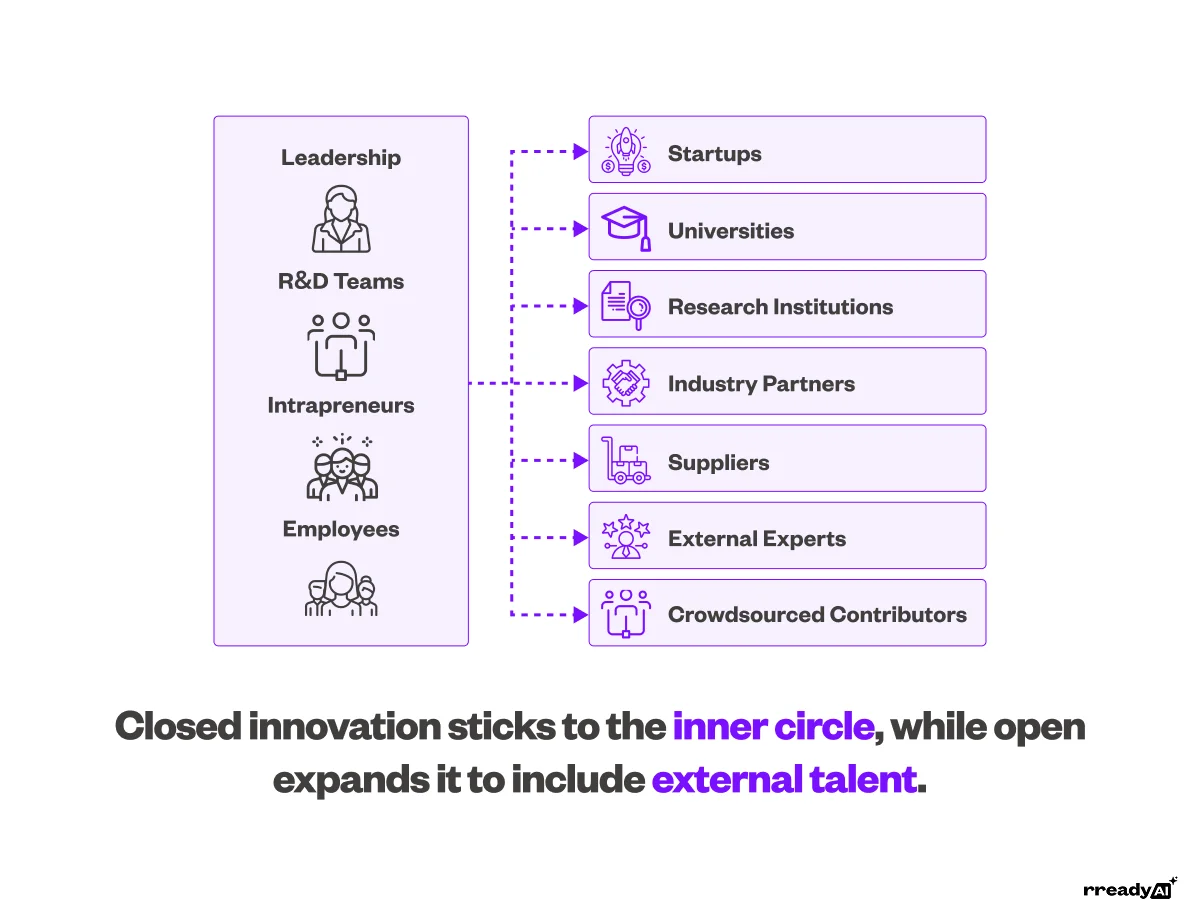
Open innovation draws on talent beyond the organization, while closed innovation relies on the people already inside it. Although this distinction may sound simple, both approaches can involve a surprisingly wide range of contributors.
In open innovation, talent can include:
Startups and scaleups
Universities and research institutions
Industry partners and suppliers
External experts and innovation communities
Crowdsourced contributors
Closed innovation, on the other hand, focuses on internal talent, such as:
Leadership and senior decision-makers
Dedicated R&D teams
Intrapreneurs and innovation leads
3. Incentives for participation
Incentives have proven to be a critical part of innovation, often shaping who participates, how motivated they are, and how much effort they’re willing to invest.
In open innovation, contributors aren’t employees, so motivation goes beyond traditional compensation. Common incentives include:
Market-based rewards
Prizes or tournament-style challenges
Reputation and visibility within a community
Opportunities for future collaboration or commercialization
Closed innovation relies on non-financial and financial incentive structures embedded within the organization. So, participation is driven by:
Salaries and bonuses
Career progression and recognition
Authority, hierarchy, and leadership direction
Top-down alignment with organizational goals
4. Innovation scope
Since open innovation draws on diverse external inputs, it’s more likely to enable radical or disruptive innovation.
Access to new perspectives and specialized knowledge allows organizations to explore opportunities beyond their existing business models and combine ideas in unexpected ways.
While closed innovation can also lead to
While closed innovation can also lead to breakthrough outcomes, it more commonly supports incremental innovation, which accounts for 98% of all innovation efforts.
This results from a structural reliance on internal knowledge and established capabilities that motivates companies to concentrate on improving existing products, services, or processes rather than pursuing fundamentally new directions.
5. Communication channels
Ideas only move forward when they can be shared, challenged, and built upon.
Open innovation uses outward-facing communication channels that connect organizations with external ecosystems.
These can include:
Innovation platforms
Partnerships
Open calls or challenges
External communities
Collaborative networks
Closed innovation relies solely on internal communication channels, so innovation discussions happen through:
Internal meetings and workshops
Project teams and cross-functional working groups
Management reviews
Internal innovation management software tools
Company-wide innovation events, hackathons, or challenges
Formal reporting structures
Pro tip:
Both open and closed innovation rely on innovation platforms for a reason. When ideas come from inside the organization, teams need a clear, shared channel to submit, discuss, and move them forward.
rready’s Idea Management platform is designed to deliver just that.
It allows organizations to:
Source ideas from across the entire workforce
Assess and develop them transparently
Keep everyone aligned throughout the innovation lifecycle
Thanks to built-in collaboration features, structured evaluation, clear workflows, and real-time reporting, communication around innovation becomes visible, inclusive, and scalable.

6. Infrastructure
Closed and open innovation are distinct governance structures, not just different innovation styles. That’s why each requires a different kind of infrastructure to work.
Open innovation requires infrastructure that supports coordination beyond the organization. This includes:
Systems to manage collaboration across organizational boundaries
Processes to absorb, evaluate, and integrate external knowledge
Clear governance for partnerships, IP, and shared development
Tools that support distributed innovation rather than centralized control
Without this supporting infrastructure, open innovation struggles to scale or fails altogether.
Meanwhile, closed innovation relies on a strong internal infrastructure, which includes:
In-house R&D capabilities and dedicated teams
Internal processes for development, validation, and quality control
Centralized decision-making and resource allocation
Proprietary development tools, internal innovation software, data systems, and secure IT environments
Clear alignment with internal strategy and standards
7. Control
Control determines who owns decisions, knowledge, and outcomes throughout the innovation process.
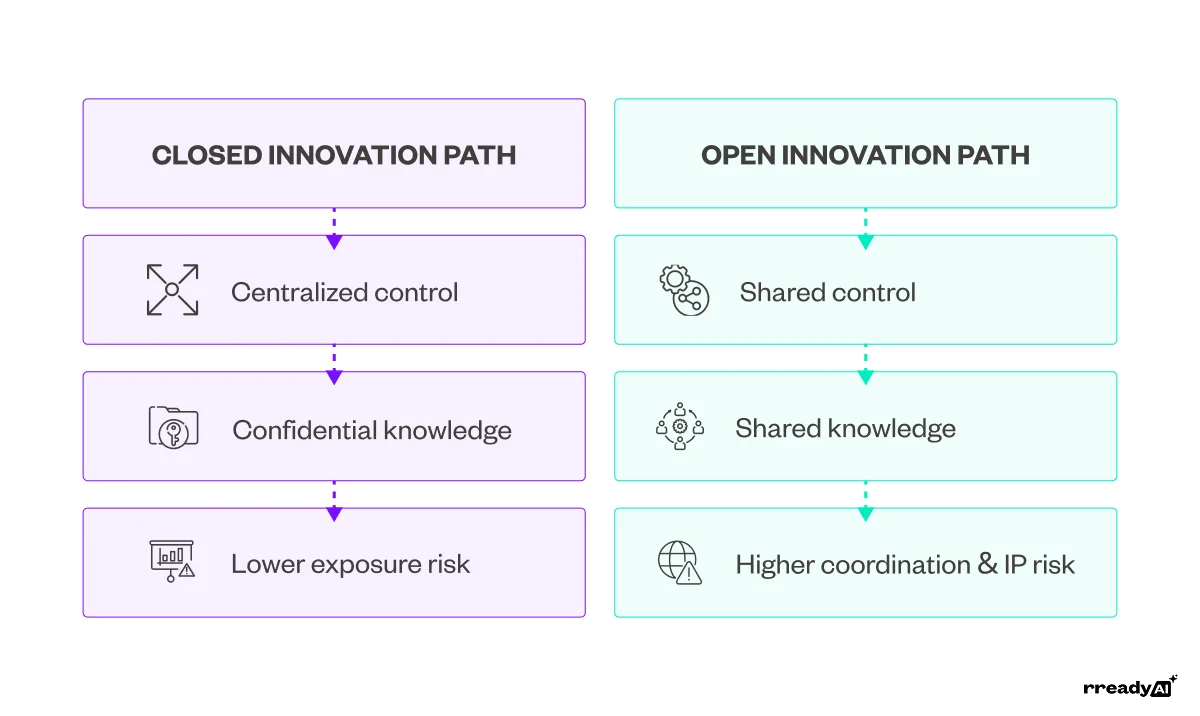
Open innovation involves shared control.
Working with external contributors means that decision-making, knowledge access, and intellectual property must be governed across organizational boundaries.
Closed innovation centralizes control within the organization.
All decisions, development activities, and intellectual property remain in-house, giving the company full authority over how innovations are created and used.
8. Confidentiality
Control and confidentiality go hand in hand.
In open innovation, confidentiality must be actively managed.
Because innovation happens across organizational boundaries, intellectual property and value are often shared, licensed, or negotiated. This means companies need clear agreements to define what information is shared, what remains confidential, and how value is captured.
Closed innovation takes a more contained approach.
Innovations are developed internally and kept confidential until they are ready for market. Knowledge, IP, and competitive advantage remain firmly within the organization, with the company acting as the sole owner of outcomes.
9. Risks
Once control and confidentiality are shared, risk becomes an important consideration.
But IP exposure isn’t the only risk companies need to manage.
Open innovation comes with other potential issues, such as:
Limited absorptive capacity, making it hard to recognize or integrate external ideas
Complex collaboration and coordination across multiple partners
Misaligned incentives or expectations between parties
Unclear ownership or governance if rules aren’t defined upfront
These risks make open innovation more demanding, requiring clear governance, strong coordination, and the ability to integrate external input.
Still, closed innovation carries its own set of risks, including:
Blind spots caused by relying solely on internal knowledge
Technologies becoming outdated due to limited exposure to external advances
Slower learning from markets, customers, or emerging trends
Overconfidence in internal expertise
Since neither open nor closed innovation is risk-free, the challenge becomes determining which risks you’re better equipped to manage.
10. Cost
Open innovation is often more cost-efficient because development efforts, resources, and expertise are shared.
By collaborating externally, companies can reduce the financial burden of R&D, avoid duplicating work that partners, startups, or research institutions have already done, and spread investment across multiple parties.
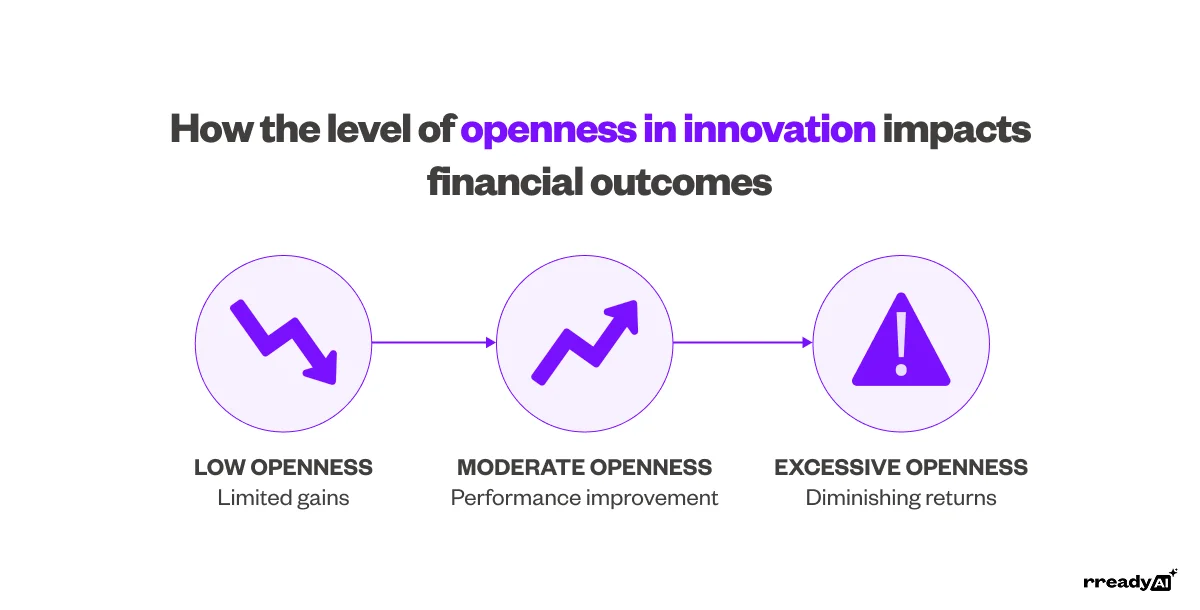
This cost efficiency can translate into stronger returns on innovation investments, but there’s a caveat. Large-scale studies show that companies with a moderate level of openness in their innovation activities tend to see better financial outcomes, while too little or too much openness limits returns.
As for closed innovation, it’s inherently more expensive. All R&D costs sit within the organization, requiring significant long-term investment in people, infrastructure, and experimentation.
Still, many companies continue to double down on internal investments, with global corporate R&D spending reaching a record $1.3 trillion in 2024, showing that high cost doesn’t diminish the strategic importance of internal innovation.
11. Speed
The speed of innovation depends largely on how many people are involved and how complex coordination and decision-making are.
That said, open innovation typically moves faster.
Studies show that organizations using this model can reduce time-to-market by up to 40%. That’s because sourcing ideas and capabilities externally allows companies to shorten development cycles, avoid reinventing the wheel, and respond more quickly to market needs.
Closed innovation tends to move more slowly.
With all development happening internally, innovation cycles depend on in-house capacity, processes, and prioritization, which can extend timelines, especially for complex or unfamiliar challenges.
12. Flexibility
When markets shift, technology evolves, or priorities change, the ability to adapt becomes a competitive advantage.
Open innovation tends to be more flexible, with surveys suggesting that around 62% of organizations see it as having a positive impact on workforce agility and adaptability.
This stems from the fact that companies can pivot faster and adjust direction without rebuilding everything internally.
Closed innovation can be flexible as well, particularly in smaller organizations.
However, as innovation becomes more embedded in internal structures and processes, changing direction often requires more time, coordination, and resource reallocation.
13. Quality
The quality of the organization’s innovative outputs usually comes down to consistency, standards, and alignment, and how easy those are to maintain at scale.
In open innovation, there can be some variability in quality because ideas and solutions come from multiple external sources.
To avoid sacrificing quality, organizations need strong governance and evaluation mechanisms that ensure outputs meet internal standards and strategic goals.
As for closed innovation, it offers tighter quality control by design.
When development is happening internally, teams work with shared standards, processes, and a unified vision, making it easier to ensure consistency and alignment across innovation outcomes.
Open innovation vs. closed innovation: Which one should you choose?
The best innovation model depends on your specific context: your goals, your challenges, and the kind of problems you’re trying to solve.
The table below helps you gauge which innovation approach is a better fit for your situation:
Decision factor | Open innovation works best when… | Closed innovation works best when… |
Nature of the problem | The problem is exploratory or ill-defined, and the solution space is broad or unknown. | The problem is well-defined, with a clear and narrow solution space. |
Distribution of knowledge | Critical knowledge is widely dispersed outside the organization. | Key knowledge is concentrated internally and deeply firm-specific. |
Need for variety vs. coordination | Generating many diverse ideas and experimenting in parallel adds value. | Tight coordination and integration across teams is essential. |
Innovation goal | You’re exploring new markets, technologies, or business models. | You’re improving or protecting existing products, processes, or technologies. |
IP sensitivity | Knowledge can be modularized, and value can be shared or licensed. | IP leakage would significantly harm competitive advantage. |
Risk appetite | You’re willing to manage the complexity of collaboration and governance. | You prefer to minimize external dependencies and uncertainty. |
Internal capabilities | Internal resources benefit from being complemented externally. | Strong in-house R&D capabilities already exist. |
Market dynamics | The market is fast-changing and requires adaptability. | The market is stable or highly regulated. |
rready: The best of both worlds
You don’t have to choose between open and closed innovation. With the right setup, you can combine the strengths of both.
rready’s KICKBOX Intrapreneurship Program allows you to do just that.
It brings the openness of broad idea sourcing into a structured, internal framework, so innovation stays aligned, executable, and owned by your organization.
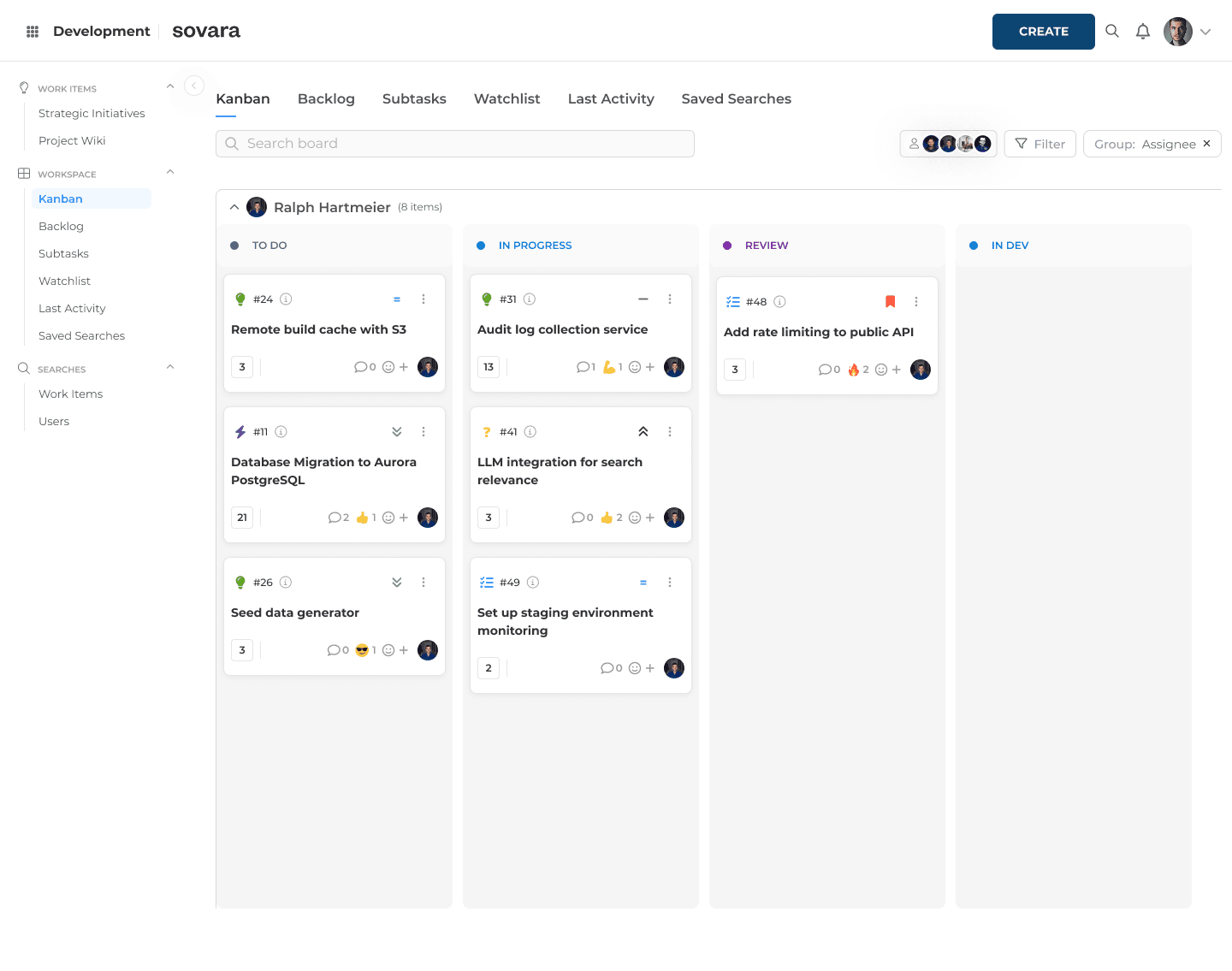
KICKBOX empowers employees to turn ideas into action using a proven methodology, a scalable digital platform, and hands-on support.
With low barriers to entry, it unlocks the collective know-how of your entire workforce, while clear stages, governance, and resources ensure ideas don’t stall after ideation.
This results in an innovation that’s inclusive, measurable, built to scale, and powered by the people who already know your business best.
Get a personalized walkthrough of the rready platform to learn how you can co-create a setup that balances openness and control in your organization.

Read more

8 idea management software benefits [Fully explained]
Discover the idea management software benefits that help you capture ideas, improve collaboration, and turn employee input into real business impact.

9 idea generation techniques businesses should use in 2026
Learn the best idea generation techniques to help you spark creativity, structure thinking, and turn ideas into actionable outcomes for your team.

Financial vs. Non-financial Incentives in Innovation
Explore the role of financial vs non-financial incentives in innovation and learn how you can motivate employees to share ideas and stay engaged.