How to Build a Productive Idea Management System [Guide]
Learn how to build a productive idea management system that captures employee insights, evaluates ideas effectively, and turns them into improvements.


Employees are far better positioned to spot improvement opportunities than executives sitting in conference rooms. After all, they’re closer to the day-to-day work, where inefficiencies hide, and small fixes can make a big impact.
British Airways learned this firsthand when an employee suggested descaling toilet pipes on aircraft, reducing weight and saving over $800,000 in annual fuel costs.
But this brilliant idea didn’t surface by chance. It came through a structured online suggestion system.
Having a system like this in place is what makes the biggest difference between organizations that occasionally hear good ideas and those that consistently capture them.
To help you join the ranks of the latter, this article breaks down how to build a productive idea management system and give every great idea a clear path forward.
Key takeaways
Start with a defined purpose, so your system produces the right ideas
Define what you want your idea management system to achieve, such as cost savings, process improvements, or new product ideas. This ensures ideas are evaluated and prioritized based on real business value, not just volume.Create a structured workflow and transparent ownership so ideas actually move forward
Define lifecycle stages, such as submission and evaluation, and assign responsibility at each step. This prevents ideas from getting stuck by making it clear who advances them and how decisions are made.Use consistent evaluation criteria to focus on ideas with the highest impact
Every idea competes for limited resources. A transparent evaluation framework with defined criteria and scoring helps you identify which ideas are worth pursuing and ensures fair, objective decision-making.Drive participation through leadership involvement and visible outcomes
Employees contribute more when they see that their ideas are taken seriously. Leadership engagement, timely feedback, and recognition create trust and motivate employees to keep sharing valuable ideas.Use dedicated idea management software to scale and manage everything effectively
Manual tools cannot keep up as idea volume grows. A platform like rready gives you the structure, visibility, and automation needed to manage ideas consistently.
9 practical steps to building an effective idea management system
At its core, idea management revolves around a simple process: generating, evaluating, and prioritizing ideas.
However, building an effective idea management system takes more than just defining this funnel.
With this in mind, here are the nine steps to building an idea management system that turns potential into performance:
Step 1: Define what you want your idea management system to achieve
Before introducing submission forms or workflows, you need to define the purpose of your idea management system. Are you trying to reduce operational costs? Improve internal processes? Generate new product ideas?
The answer shapes everything that follows, from how ideas are evaluated to who reviews them.
Step 2: Choose the structure and scope
The structure and scope of participation determine how diverse, focused, and manageable your idea flow will be. That’s why one of the first things you should do is decide how open the idea management system will be.
An open system invites contributions from across the organization and beyond it, including customers, partners, and external stakeholders. This expands the range of perspectives and increases the likelihood of surfacing ideas that you can use.
A more focused system, on the other hand, limits participation to specific teams, roles, or initiatives. This makes it easier to evaluate ideas quickly and ensures submissions stay closely aligned with defined priorities.
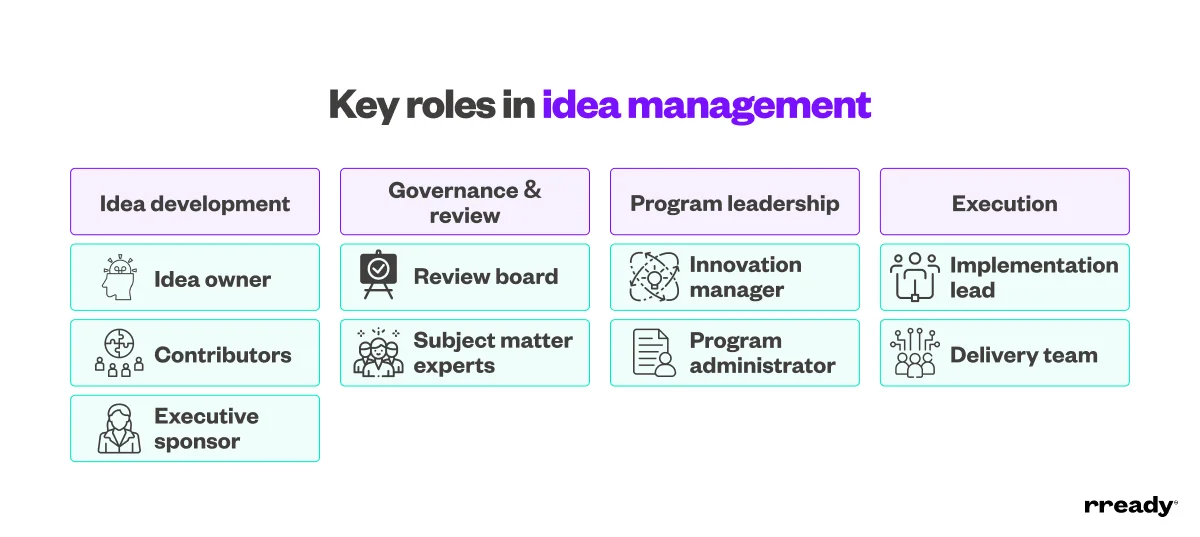
Step 3: Assign transparent ownership and responsibilities
Behind every submitted idea is someone who took the time to notice a problem and suggest a better way forward.
However, without clear ownership on the other side, that idea will remain nothing but a missed opportunity. Over time, this might lead to participation dropping because employees will stop believing their input leads anywhere.
So, at a minimum, your system should answer questions like:
Who reviews new ideas first?
Who evaluates feasibility and business impact?
Who makes approval decisions?
Who provides feedback at each stage?
This clarity creates accountability and momentum, making ideas move faster through the system.
Step 4: Structure the idea lifecycle
A productive idea management system defines exactly how ideas move from submission to selection, with specific stages, decision points, and expectations along the way.
With a well-designed workflow, everyone understands what happens next, and every idea is assessed using the same criteria.
A typical idea workflow includes the following stages:
Submission: Ideas are captured in a central, accessible place, ensuring valuable insights don’t get lost in emails, chats, or meetings.
Screening: To keep the pipeline clean and focused, initial review checks for duplicates, missing information, or ideas that fall outside the scope.
Evaluation: Ideas are assessed based on feasibility, impact, and alignment with organizational priorities, ensuring that decisions are based on value, not visibility or persistence.
Prioritization: High-potential ideas are ranked to determine which ones should move forward first, helping allocate attention and resources where they matter most.
Closure and feedback: Outcomes are documented, and contributors receive feedback, which builds trust, reinforces transparency, and encourages continued participation.
Pro tip:
When your idea management system starts working, you won’t just get a few ideas; you’ll get dozens, hundreds, or even thousands of them.
Reviewing, structuring, and evaluating them all manually quickly becomes unsustainable, leading to bottlenecks, slower feedback, and valuable ideas being overlooked.
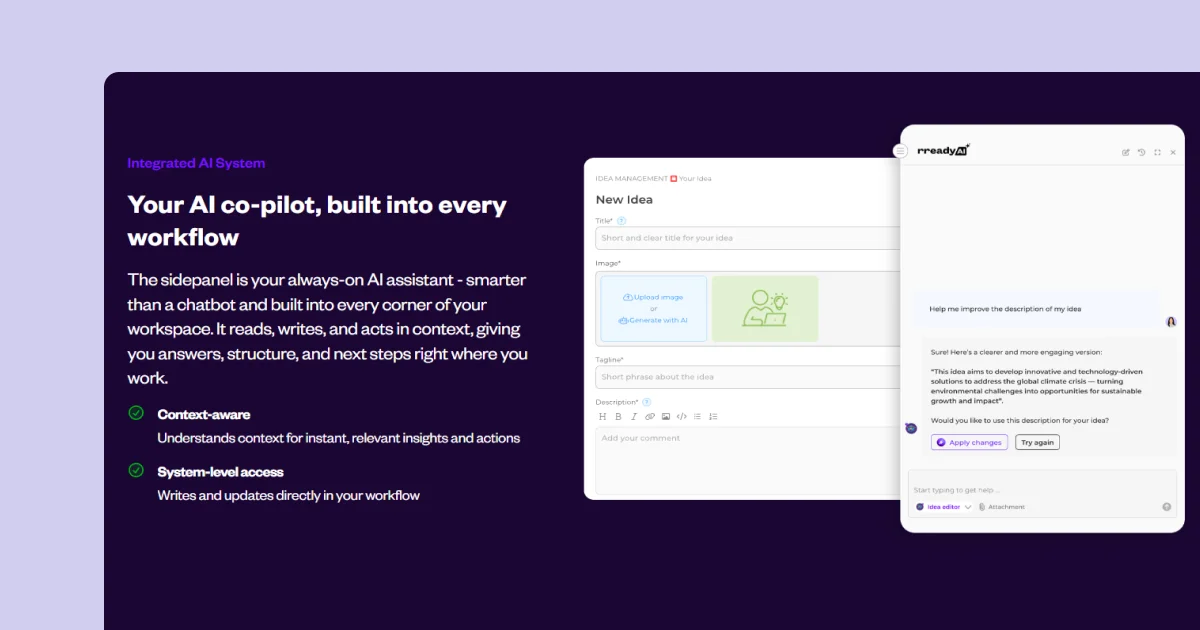
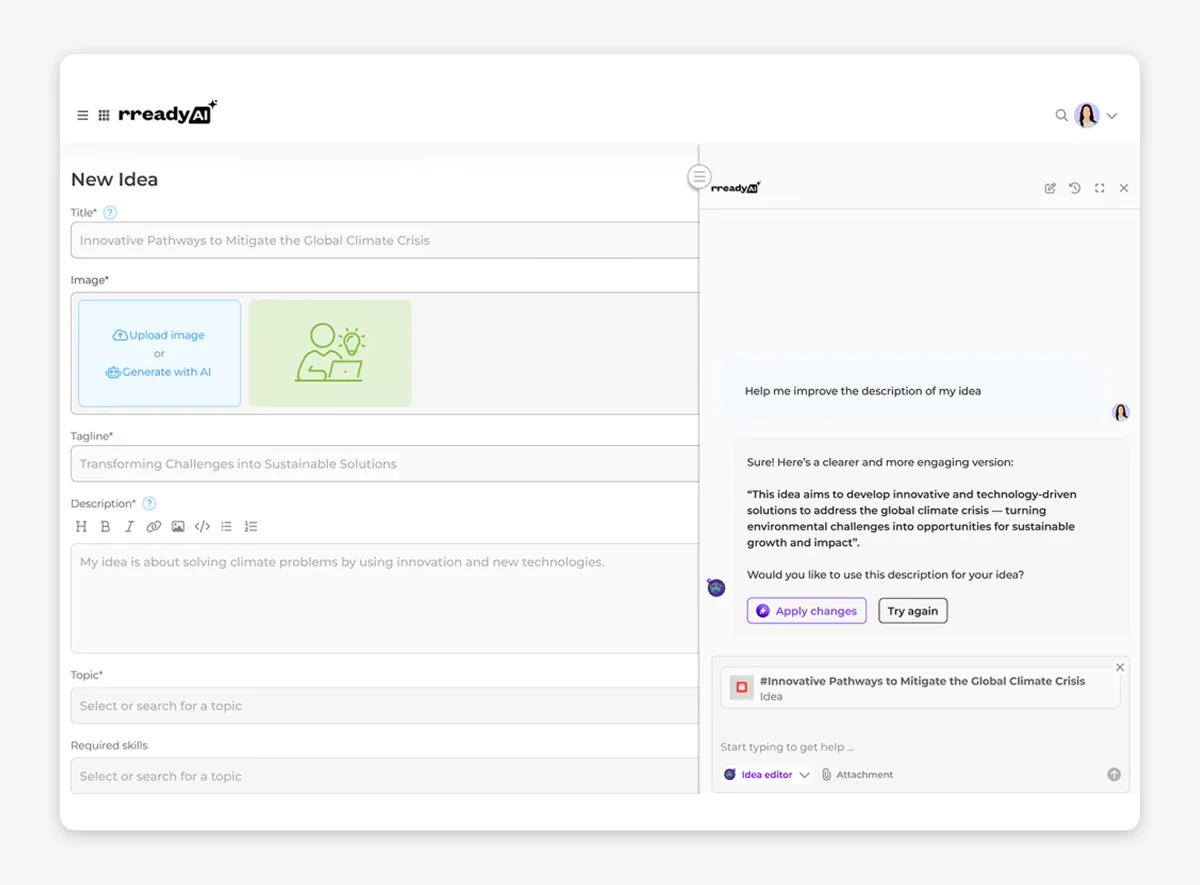
Artificial intelligence (AI) helps avoid these scenarios by accelerating each stage of the workflow.
With rready’s AI-native platform, you can:
Automatically structure raw ideas into complete proposals, making them easier to understand and evaluate from the start
Detect duplicate or highly similar ideas instantly, reducing redundancy and keeping your pipeline focused on unique opportunities
Assess feasibility, impact, and alignment using AI-driven scorecards, helping teams identify the most promising ideas faster
Compare ideas against strategic goals, market signals, and internal data to highlight which initiatives deserve attention first
Track outcomes and ROI automatically, providing visibility into which ideas delivered real value and why
Step 5: Build a consistent framework for evaluating ideas
Every idea competes for limited time, budget, and attention. The evaluation stage determines which ones are worth that investment, which makes it arguably the most important part of the entire process.
That’s why it’s critical to define a transparent evaluation framework upfront. You can do so by:
Setting concise evaluation criteria: Assess ideas based on factors like strategic alignment, expected impact, feasibility, and implementation effort to ensure they are judged on their real potential.
Using a consistent scoring system: Assign scores or weights to each criterion to create an objective basis for comparison, making it easier to prioritize ideas fairly and consistently.
Combining quantitative and qualitative feedback: Scores provide structure, but written feedback explains the reasoning behind decisions, helping contributors understand outcomes and improve future submissions.
Make sure ideas are evaluated by the right expertise: To ensure more accurate and actionable assessments, involve reviewers who understand the operational, technical, and business context of the idea.
Documenting evaluation outcomes: Capture decisions and reasoning so ideas can be revisited, refined, or reconsidered later if priorities change.
Step 6: Drive participation through deliberate engagement tactics
Idea management systems have evolved significantly, from physical suggestion boxes to AI-powered platforms. However, one thing has always remained true: Participation depends on whether people believe their ideas matter.
When organizations actively recognize contributions, communicate openly, and show progress, idea volume and quality increase significantly.
The table below outlines proven incentive schemes and tactics organizations can use to sustain employee engagement and turn idea management into a reliable source of innovation.
Tactic | Description | Example | Result |
Public recognition | Acknowledge contributors visibly to reinforce that participation is valued. | The authors of highest-rated ideas are highlighted in company-wide meetings or internal newsletters. | Encourages repeat participation and increases motivation |
Timely feedback | Provide clear feedback on submitted ideas, regardless of outcome. | The reviewer leaves comments explaining why an idea was approved, rejected, or needs refinement. | Builds trust and improves future idea quality |
Transparent progress tracking | Allow contributors to track the status of their ideas. | Employees can see whether their idea is under review or approved. | Maintains engagement and reduces uncertainty |
Peer collaboration | Enable others to comment on and refine ideas. | Colleagues suggest improvements or build on existing submissions. | Improves idea quality and feasibility |
Financial rewards | Provide monetary incentives for high-impact ideas. | Cash bonus, profit-sharing, or a percentage of savings generated goes to the employee. | Increases participation, especially for operational improvements |
Non-financial incentives | Use recognition, growth, or visibility instead of only financial rewards. | Top contributors are featured in internal profiles or innovation showcases. | Strengthens intrinsic motivation and long-term engagement |
Career visibility and advancement | Tie idea contributions to career growth and internal visibility. | Contributors are recognized in performance reviews or promotion discussions. | Encourages sustained, high-quality participation |
Step 7: Make leadership visibly and actively involved
Employees pay close attention to what leaders do.
That’s why the leadership’s role should go far beyond approving ideas or offering incentives.
Effective leaders actively reinforce the system by participating in it themselves. This includes submitting ideas, commenting on submissions, and taking part in innovation challenges to signal that idea management is a shared responsibility. Leaders can also use feedback insights from eNPS software to understand how employees feel about the process and improve participation over time.
Leaders can also support the idea management system by encouraging experimentation and, more importantly, tolerating failure as part of learning. This approach creates psychological safety that makes employees comfortable contributing bold ideas.
Step 8: Choose software that supports and scales your idea management system
As you build your idea management system, one thing becomes obvious quickly: Manual processes break down as idea volume grows.
Introducing a dedicated idea management software solution is the best way to maintain structure, transparency, and momentum across your idea pipeline.
When choosing a platform, focus on software that supports your existing process, not one that forces you to change it. Look for:
Easy idea submission and collaboration: The system should make it effortless for employees to contribute and build on ideas.
Configurable workflows and scoring: You should be able to define evaluation criteria, routing, and approval stages based on your needs.
Integrations with existing tools: Ideas should connect seamlessly with tools like Jira, Teams, or Asana to support implementation later on.
Analytics and reporting: The platform should help you track participation, evaluate impact, and measure outcomes.
Enterprise-grade security and compliance: Features like single sign-on (SSO), audit trails, and access controls ensure your data remains secure.
Pro tip:
Evaluating software against these criteria takes time. Choosing an established platform like rready simplifies that decision by supporting the exact capabilities a scalable idea management system requires.
rready’s Idea Management enables you to:
Capture ideas in a structured, intuitive way that encourages participation
Apply consistent evaluation and scoring criteria across all submissions
Connect ideas directly to your existing tools and workflows through native integrations
Maintain visibility across the entire idea pipeline with real-time dashboards
Support participation and collaboration at scale with built-in engagement features
Scale seamlessly across teams, departments, and locations as idea volume grows
Step 9: Measure ROI and prove the value of your idea management system
If you can’t measure the impact of your idea management system, it becomes difficult to justify the time, resources, and investment behind it.
To understand whether your system is working, focus on metrics that reflect engagement, cultural adoption, system effectiveness, and operational efficiency, such as:
Participation rate: How many employees are contributing ideas?
Cycle time throughput: How long does it take for ideas to move through evaluation once submitted?
Strategic alignment: How many shared ideas directly support key organizational priorities?
Best practices for building an effective idea management system
Whether you’re introducing an idea management system or improving an existing one, these best practices help ensure it’s adopted, trusted, and capable of delivering real results:
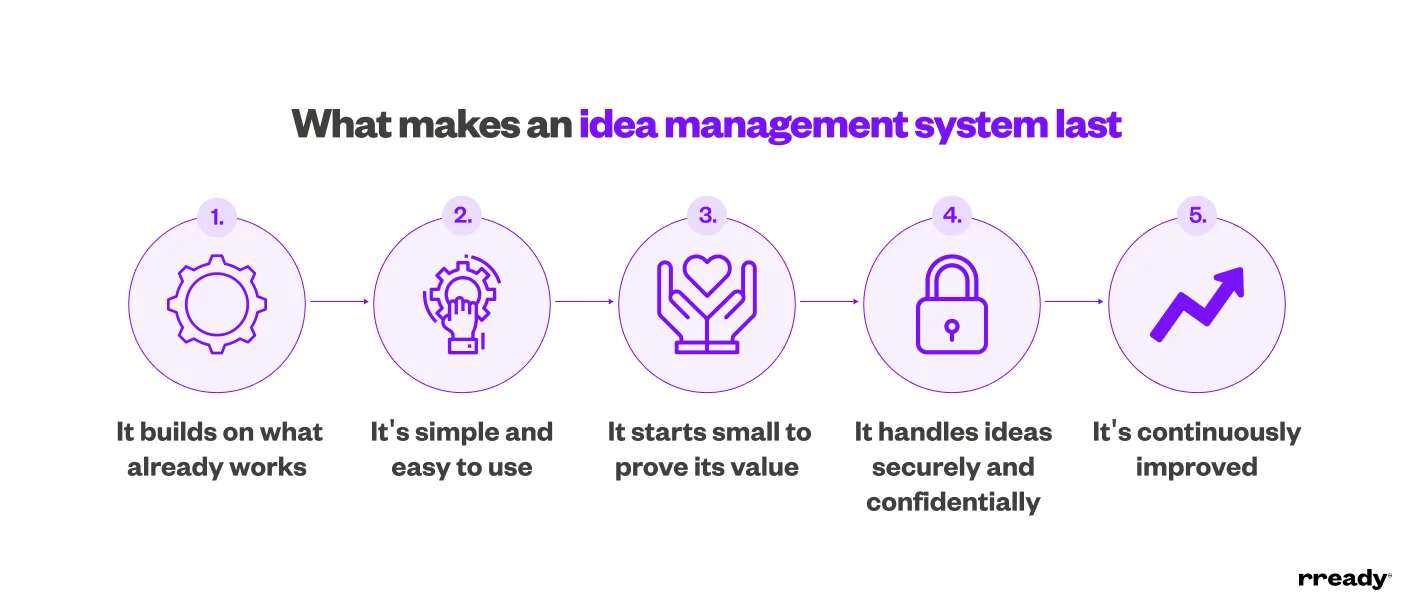
Start with your existing processes: Map how ideas currently flow through your organization, and identify where they get stuck. Building on what already works makes adoption smoother and avoids unnecessary disruption.
Keep the process simple and easy to use: The more effort it takes to submit or review ideas, the fewer ideas you’ll get. A clear, straightforward process lowers barriers and encourages participation.
Start with a pilot before scaling: Test your system in one team or department first. This allows you to refine workflows, prove value, and build internal momentum before expanding organization-wide.
Protect sensitive information and intellectual property: Ensure ideas are handled securely and confidentially when needed. This builds trust and protects valuable organizational knowledge.
Continuously improve the system based on data: Track participation, implementation rates, and outcomes. Use these insights to refine your process and ensure the system stays effective over time.
Make your idea management system easier to run with rready
When you have robust software at the core of your idea management system, everything else becomes easier to manage.
This is where rready makes the difference, providing the structure and visibility needed to turn idea management into a reliable, scalable business function.
Ideas move forward consistently, participation stays high, and progress remains visible without relying on manual coordination.
Want to see what this looks like in practice? Arrange a personalized walkthrough, and discover how rready helps you unlock the full value of your ideas.

Read more

8 idea management software benefits [Fully explained]
Discover the idea management software benefits that help you capture ideas, improve collaboration, and turn employee input into real business impact.

9 idea generation techniques businesses should use in 2026
Learn the best idea generation techniques to help you spark creativity, structure thinking, and turn ideas into actionable outcomes for your team.

Financial vs. Non-financial Incentives in Innovation
Explore the role of financial vs non-financial incentives in innovation and learn how you can motivate employees to share ideas and stay engaged.