Financial vs. Non-financial Incentives in Innovation
Explore the role of financial vs non-financial incentives in innovation and learn how you can motivate employees to share ideas and stay engaged.


Innovation is ultimately driven by people.
However, with global employee engagement at just 21%, many employees lack the drive to push ideas forward.
This disengagement costs the global economy an estimated $438 billion in lost productivity each year. It can also cost organizations their next big breakthrough, as engaged employees are far more likely to contribute ideas, experiment, and solve problems.
So, how can organizations encourage employees to actively participate in innovation?
One answer lies in incentives.
When people feel that their ideas are valued, they’re far more likely to actively contribute to innovation and far less likely to think about quitting.
In this guide, we’ll take a closer look at financial vs. non-financial incentives in idea and innovation management and break down how they differ, so you can implement the incentives that actually motivate your employees to innovate.
Key takeaways
Financial incentives drive participation through tangible rewards
Monetary incentives such as bonuses, profit sharing, stock options, and patent bonuses motivate employees by linking innovation efforts to clear financial benefits.Non-financial incentives strengthen engagement and creativity
Recognition, autonomy, development opportunities, and collaboration encourage employees to share ideas and stay engaged in innovation beyond financial rewards.Each incentive type influences behavior differently
Financial incentives reward measurable outcomes like implemented ideas or patents, while non-financial incentives encourage participation, creativity, and collaboration.The strongest innovation programs combine both approaches
Financial rewards help spark participation, while non-financial incentives sustain motivation and creative thinking over time.Designing the right incentive system requires structure and tools
rready’s Innovation Incentive Playbook shows how to combine financial and non-financial incentives effectively, helping organizations design reward systems that motivate participation while supporting long-term innovation.
What are financial incentives in innovation? 6 common examples
Financial incentives in idea and innovation management are monetary rewards used to motivate employees to contribute ideas and participate in innovation activities. They are based on a simple premise: When certain behaviors are rewarded financially, people are more likely to engage in them repeatedly.
While the term may sound self-explanatory, financial incentives involve more than handing out cash. They can take different forms of monetary compensation or financial benefits.
Below are six of the most common financial mechanisms organizations use to reward and encourage innovation.
1. Cash bonuses
Cash bonuses are direct monetary rewards given to employees for contributing valuable ideas or achieving innovation-related milestones.
They are among the most common financial incentives because they provide a clear, immediate reward that employees can easily understand.
In idea and innovation management, cash bonuses work best when the criteria are transparent and tied to meaningful contributions, such as helping bring new solutions to life.
2. Vouchers
This financial incentive rewards employees with tangible benefits such as vouchers and gift cards in exchange for their contributions to innovation.
Unlike direct cash bonuses, vouchers are typically tied to specific categories or vendors, which makes them less flexible in how they can be used.
However, this can also be advantageous when organizations want to align rewards with certain goals or themes, such as learning or well-being. Vouchers can also be tailored to specific occasions or employee needs, making the reward feel more personalized and intentional rather than purely transactional.
3. Profit sharing
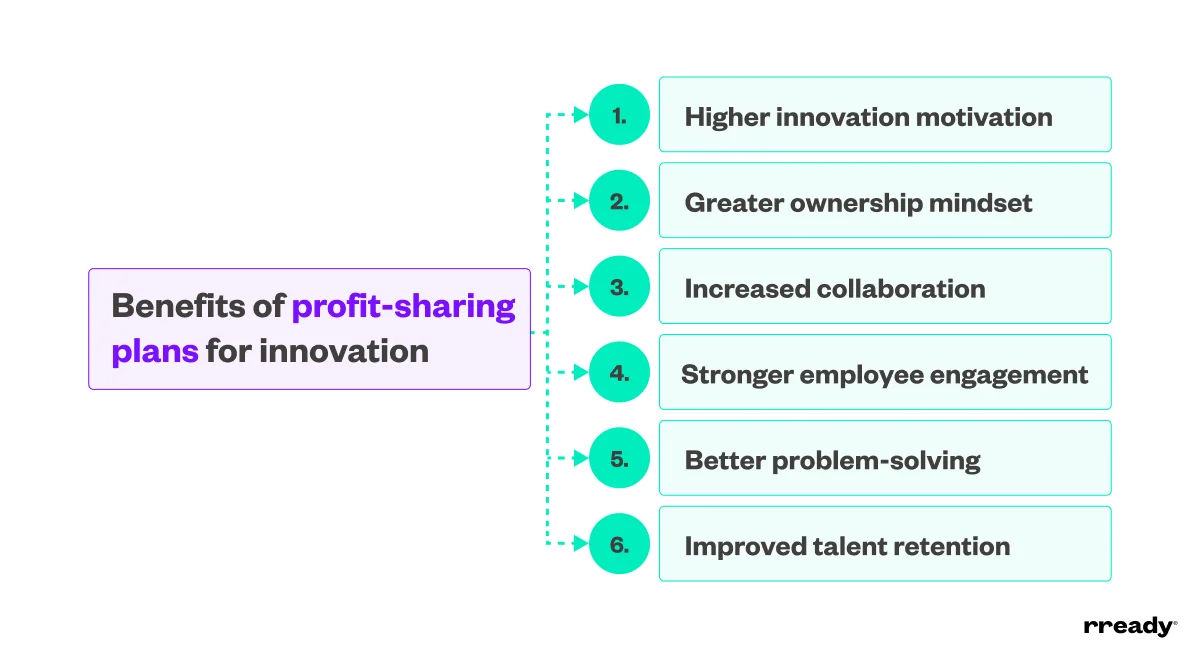
Profit sharing is a financial incentive that allows employees to receive a portion of the profits generated by successful innovations or overall company performance driven by those innovations.
Instead of rewarding a single action, this approach connects employees to the long-term financial success of the ideas they help create.
This financial incentive works well because it gives employees a stronger sense of ownership over innovation outcomes.
4. Stock options or equity incentives
Stock options and equity incentives give employees a financial stake in the company by allowing them to buy shares at a predetermined price or receive equity as part of their compensation.
This approach connects employees to the company’s long-term growth, which encourages them to focus on ideas that create sustainable value for the business.
5. Patent bonuses
Patent bonuses are financial rewards given to employees when they file for or are granted a patent for an invention or technology.
These bonuses recognize the effort involved in developing patentable innovations and encourage employees to formalize and protect valuable intellectual property, securing it as a competitive asset for the organization.
6. Paid time off
Although paid time off (PTO) isn’t a direct monetary reward, it still carries clear financial value.
This incentive allows employees to recharge, which can indirectly support creativity and sustained innovation performance.
As an incentive, PTO works well because it balances financial value with personal well-being, reinforcing the idea that contributions to innovation are both recognized and rewarded in meaningful ways.
What are non-financial incentives in innovation? 6 common examples
Non-financial incentives in innovation are rewards that motivate employees without offering direct monetary compensation. While they don’t involve cash, non-financial incentives still provide meaningful value.
These incentives focus on recognition, autonomy, personal development, and other factors that support employees’ psychological and professional needs.
Below are some of the most common non-financial incentives organizations use to encourage employee participation in innovation.
1. Public recognition and praise
Public recognition highlights employees’ contributions to innovation through visible acknowledgment within the organization, such as:
Featuring successful ideas in company-wide newsletters or internal communications
Recognizing innovators during all-hands meetings or town halls
Highlighting innovation contributions on internal platforms or idea boards
Presenting internal innovation awards for standout ideas or projects
By celebrating ideas and achievements openly, organizations reinforce a culture where innovation is valued and employees feel seen.
Pro tip:
Automate public recognition with idea management tools like rready to consistently highlight employee contributions.
rready's Idea Management platform features a community leaderboard highlighting the top 20 most active innovators, based on activity such as idea submissions, discussions, and reactions.

By continuously showcasing the employees who actively contribute, organizations can celebrate innovation in a scalable way while making participation visible across the company.
2. Career advancement and development
Career advancement and development incentives reward innovation by linking idea contributions to opportunities for professional growth.
When employees see that participating in innovation can help them build skills, gain visibility, or take on new responsibilities, they are more likely to stay engaged.
This can include:
Access to specialized training or innovation-related skill development
Leading an innovation project or cross-functional initiative
Mentorship from senior leaders or innovation experts
Participation in innovation workshops, accelerators, or internal labs
Promotion opportunities tied to strong innovation contributions
3. Flexible work arrangements
This non-financial incentive supports innovation by giving employees greater control over when and where they work. It can be done through:
Flexible working hours
Remote or hybrid work options
Additional leave or personal days
Dedicated time for creative work or idea development
Dedicated innovation time often works best when combined with the financial support mechanisms, as this combination gives employees the resources to actually develop their ideas.
For instance, organizations may allow employees to explore ideas during dedicated work hours and then use the highly beneficial intrapreneurship programs like KICKBOX to prototype and validate the most promising ones.
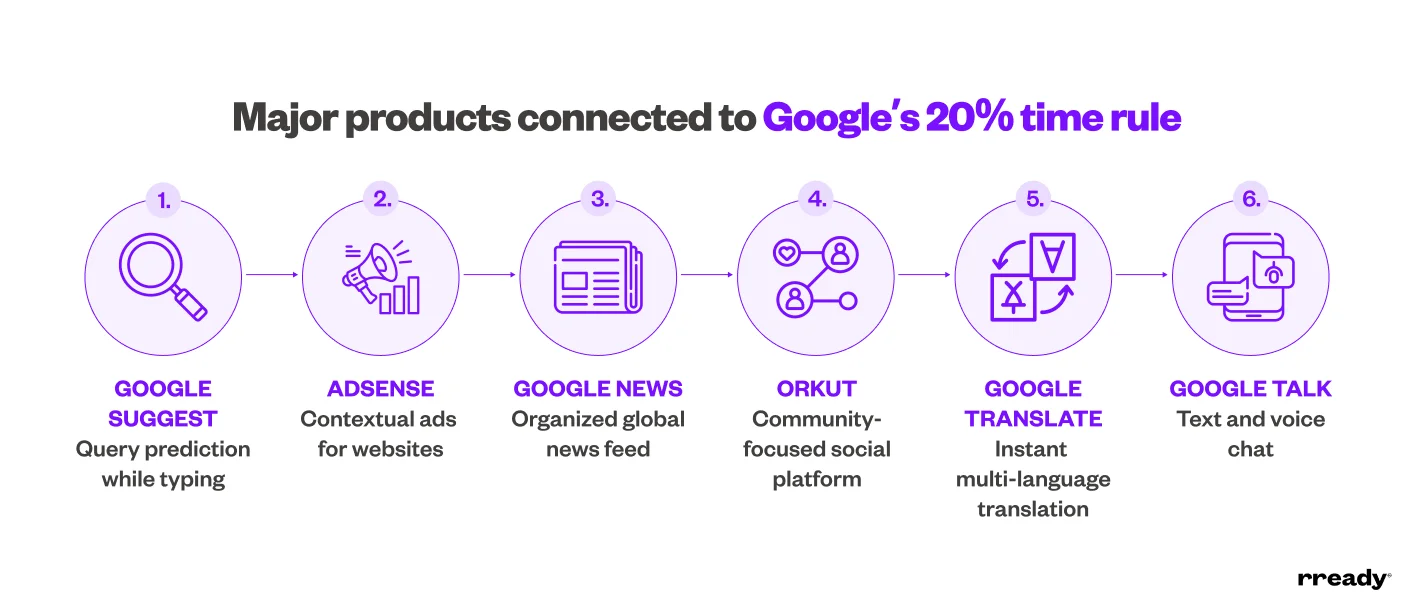
This approach mirrors the well-known idea management example popularized by Google, where employees could spend 20% of their workweek exploring new ideas that later evolved into products.
4. Autonomy in decision-making
Research consistently shows that higher levels of job autonomy are linked to stronger innovative behavior and creative performance.
As a non-financial incentive, autonomy gives employees a greater sense of ownership and influence over innovation efforts, making participation feel meaningful rather than mandated.
This can be achieved through practices like:
Allowing employees to lead innovation projects or pilot new initiatives
Giving teams the freedom to decide how to approach solving innovation challenges
Involving employees in evaluating and selecting ideas to pursue
Allowing employees to define their own innovation goals or areas of experimentation
5. Cross-department collaboration opportunities
Innovation often happens at the intersection of different perspectives.
Creating opportunities for employees to collaborate across departments can act as a powerful non-financial incentive, helping people feel more connected to the organization and its broader goals.
The opportunities in question include:
Forming cross-functional teams to tackle innovation challenges
Hosting company-wide ideation workshops or hackathons
Creating innovation communities where employees from different departments can collaborate
Implementing idea management software that enables employees to collaborate on, refine, and build on each other’s ideas
When employees interact with colleagues outside their immediate team, they gain new insights, build stronger relationships, and become more motivated to contribute ideas.
This approach also supports inclusive innovation, where ideas can come from anywhere in the organization, not just a single team or function.
6. Internal reputation or status as an innovator
When employees consistently contribute ideas or play a key role in innovation initiatives, they often gain informal status as trusted innovators within the organization.
This recognition can be a powerful motivator, as employees value the credibility and influence that come with being known for driving positive change.
Besides public praise, organizations can contribute to this reputation by creating visible pathways for innovators to build credibility across the company. This can be done by:
Featuring top innovators in internal case studies or innovation success stories
Inviting frequent contributors to innovation panels, demo days, or leadership briefings
Appointing active innovators as mentors or ambassadors within innovation programs
Financial vs. non-financial incentives in innovation: 7 key differences
The main difference between financial and non-financial incentives lies in the nature of the reward itself.
However, these incentives also differ in how they affect motivation, creativity, and long-term engagement.
The table below highlights the seven key differences between financial vs. non-financial incentives in innovation, helping organizations understand when and how to use each type.
Category | Financial incentives | Non-financial incentives |
1. Focus of reward | Linked to measurable results, such as implemented ideas, patents, revenue impact, or cost savings | Rewarding effort, participation, creativity, or collaboration within innovation programs |
2. Purpose | Rewarding specific outcomes and aligning employee efforts with measurable business goals | Encouraging creativity, experimentation, and contribution, while also recognizing meaningful innovation outcomes |
3. Motivation type | Primarily linked to extrinsic motivation, where employees may be influenced by external rewards such as bonuses or financial benefits, while still supporting intrinsic motivation in some cases | Primarily supporting intrinsic motivation, where employees feel recognized, empowered, or personally invested, while also reinforcing external validation through recognition and visibility |
4. Sustainability of motivation | Creating strong short-term motivation, with impact potentially decreasing once the reward has been received | Sustaining motivation over time, as recognition, autonomy, and development opportunities help build long-term engagement and commitment |
5. Employee perception | Viewing financial incentives as tangible and immediate rewards for specific achievements or contributions | Recognizing non-financial incentives as more personal and meaningful, reinforcing recognition, growth, and belonging within the organization |
6. Impact on creativity | Supporting structured (constrained) creativity, but may be less effective for open-ended creativity if overly tied to specific outcomes | Encouraging exploration and experimentation by rewarding participation and idea sharing rather than only final outcomes |
7. Cost to the organization | Involving direct financial costs, as organizations allocate budget for bonuses, profit sharing, or other monetary rewards | Having lower direct financial costs, but requiring a supportive culture, leadership commitment, and appropriate innovation structures |
Financial vs. non-financial incentives in innovation: Why not both?
Financial and non-financial incentives are often framed as competing approaches.
In reality, one isn’t necessarily better than the other, as each can be used to serve a different purpose in motivating employees to contribute ideas and participate in innovation.
That’s why the most successful innovation programs combine both types of incentives. Financial rewards can spark participation, but recognition, autonomy, and culture are what keep innovation going over time.
However, designing the right mix is often easier said than done, as incentives need to align with company strategy, fit the organization’s culture, and motivate the behaviors that actually drive innovation.
That’s exactly why rready created the Innovation Incentive Playbook, a practical guide to designing incentive systems that truly support innovation.
By downloading the playbook, you’ll learn how to:
Combine financial and non-financial incentives in a way that drives both participation and long-term innovation
Design incentive systems that align with your company’s strategy, culture, and innovation goals
Identify which behaviors your incentives should reward
Build a fair and transparent evaluation process that employees trust
Avoid common pitfalls and unintended side effects of poorly designed incentives
Implement a scalable system that works across teams, departments, and roles
Afterward, you can book a personalized demo to see how rready can become part of your innovation incentive efforts, helping you recognize contributors, encourage collaboration, and support employee-driven innovation.

Read more

8 idea management software benefits [Fully explained]
Discover the idea management software benefits that help you capture ideas, improve collaboration, and turn employee input into real business impact.

9 idea generation techniques businesses should use in 2026
Learn the best idea generation techniques to help you spark creativity, structure thinking, and turn ideas into actionable outcomes for your team.
Financial vs. Non-financial Incentives in Innovation
Explore the role of financial vs non-financial incentives in innovation and learn how you can motivate employees to share ideas and stay engaged.