AI in Digital Sovereignty: What You Need to Know in 2026
Discover the role of AI in digital sovereignty, including governance, compliance risks, data control, and sovereign AI best practices.


AI in digital sovereignty means controlling which AI systems handle your data, who governs them, and where they store what your employees share with them. For most organizations, data control means one thing: the right servers, the right jurisdiction, the right contracts.
Those guarantees don't extend to AI endpoints.
Your data may sit in EU-compliant infrastructure, but the moment an employee uses an embedded AI feature, what they share travels to the vendor's AI endpoint. You have no say in where it's processed, where it's retained, or what happens to it next.
With the EU AI Act set to become fully enforceable on August 2, 2026, organizations can no longer treat AI governance as a future concern. 80% of business leaders identify cybersecurity as their biggest barrier to AI strategy, and 91% consider data security and privacy central to their AI approach.
AI is already affecting your digital sovereignty. What matters now is whether you're managing that impact or absorbing it.
This guide will help you understand what AI in digital sovereignty involves, which risks to watch for, and what a sovereign approach to AI actually looks like.
Key takeaways
AI sovereignty is about who governs the AI processing your data, not just where that data is stored
Most data residency contracts say little about the AI systems reading and acting on that data. Model behavior, training data use, and output ownership all determine how much control you actually have.
AI introduces four risks that traditional sovereignty frameworks don't cover
Training data opacity, vendor lock-in, shadow AI, and exposure to EU AI Act compliance all fall outside the scope of standard data residency frameworks. Each one can erode control before you notice it.
AI can reinforce sovereignty when deployed under your control
Automated compliance monitoring, in-platform AI processing, and language-agnostic translation all work in your favor when the AI doing the work never leaves your governed environment.
rready and sovara are built for organizations that want to act on this
rready's sovereign platform lets you choose which AI processes your data, including the option to bring your own. For broader work management, sovara is rready's sovereign European alternative to tools like Jira and Confluence, built around the same approach to AI control.
What is AI in digital sovereignty?
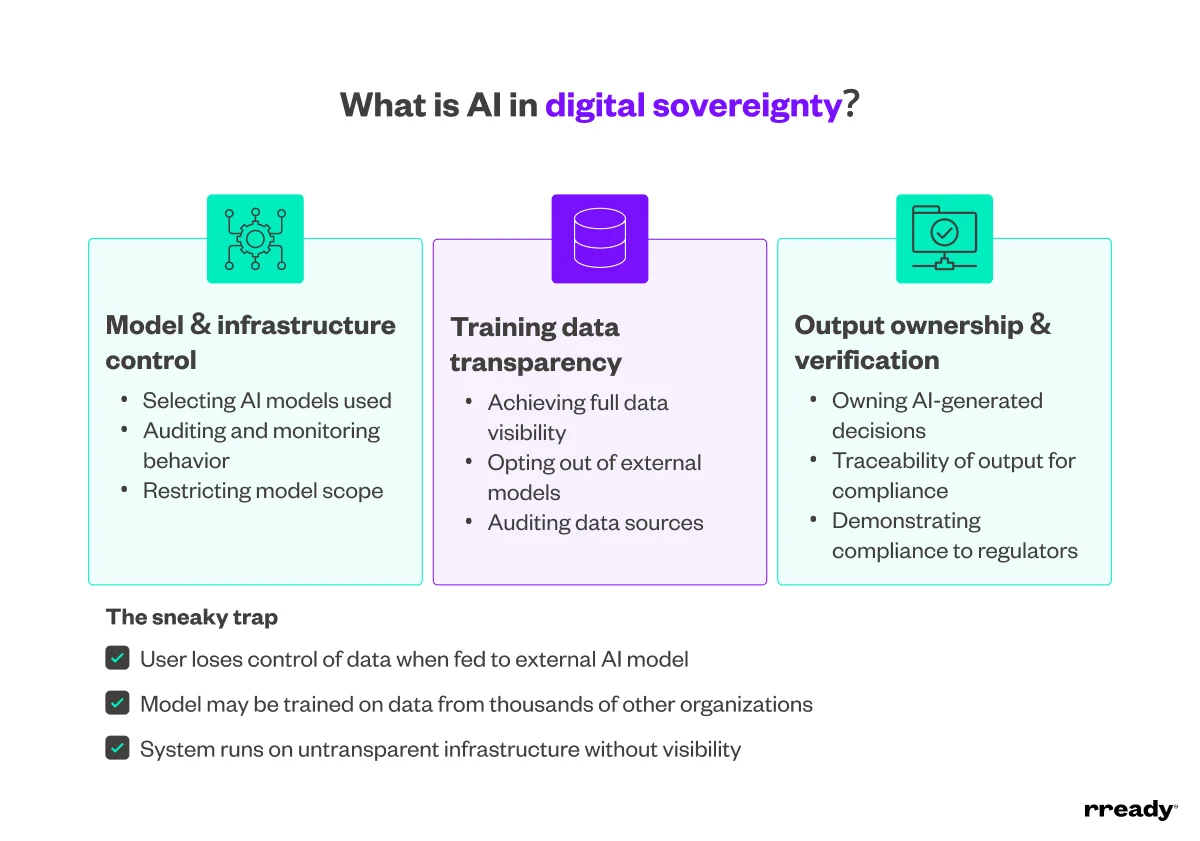
AI in digital sovereignty means maintaining control over the AI systems processing your data. That includes which models are used, how they're trained, where they operate, and who can access or override their outputs.
Data residency is only part of it. You can store data in EU-based servers and still lose control the moment it's fed into an AI model you don't own.
That model may be trained on data from thousands of other organizations, running on infrastructure you have no visibility into, and updated without any notification.
Three specific areas define whether your AI use is sovereign:
Model governance: Do you know which model version is processing your data? Can you audit its behavior, restrict its scope, or replace it without rebuilding your workflows?
Training data transparency: Do you have the right to know how your data contributes to model training, or to request that it be excluded? Most public AI terms of service leave these questions deliberately vague.
Output ownership: Who owns the decisions or recommendations the AI generates from your data? Can you demonstrate to regulators how those outputs were produced?
If answers to those questions all point to your vendor rather than to you, you're already operating with less control than you realize.
Why AI raises the sovereignty stakes
Data storage was once the main sovereignty concern. With AI now part of how data gets processed, that scope has expanded. Your data is not stored passively. It is processed, analyzed, and potentially absorbed into systems you may not control.
When a developer asks an AI assistant to review code, summarize a ticket, or draft documentation, that content doesn't just stay within your tool. The vendor's AI processes it, may retain it, and can use it to shape how the model behaves going forward.
The stakes are especially high for IT teams. Roadmaps, security incidents, architecture decisions, and infrastructure details regularly flow through these tools. Most organizations have no governance over the AI systems reading them.
AI vendors can also update their models unilaterally. A model that behaved one way last quarter may behave differently today, with no notification required.
As MIT Technology Review noted, many organizations made a tacit bargain when adopting AI: capability now, control later. In 2026, "later" has arrived.
4 AI-specific risks to your digital sovereignty
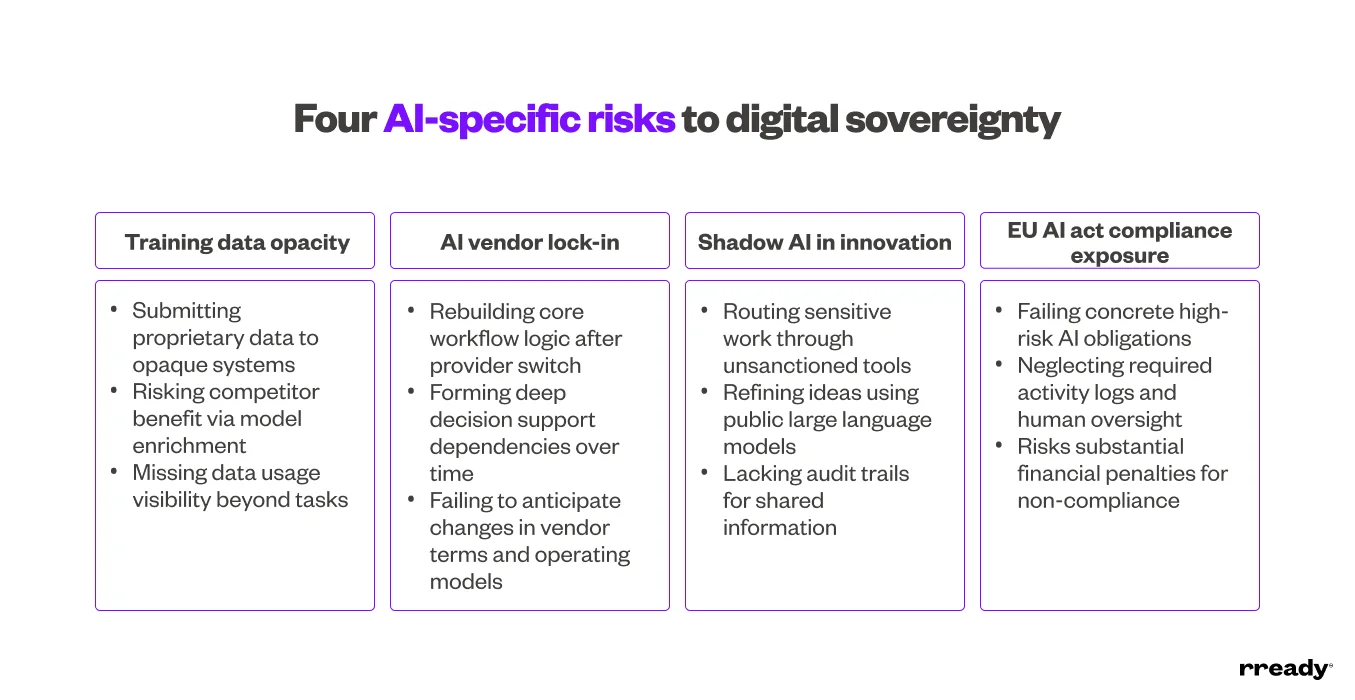
AI introduces sovereignty risks that standard data storage controls don't cover. Here are the four most important ones:
1. Training data opacity
Most organizations have no visibility into how their data interacts with the AI models they use. When you submit data to a third-party AI system, you often can't determine whether it's been:
Used to improve the underlying model
Aggregated with data from other clients
Retained beyond the scope of the immediate task
This creates a specific risk: Your proprietary information may indirectly enrich a model that benefits your competitors. And because the process is invisible, you can't detect it until it's too late.
2. AI vendor lock-in
Platform lock-in has been a sovereignty concern for years, but AI lock-in is harder to escape. When AI powers your core workflows, changing providers requires more than migrating data. You also have to rebuild:
The logic and evaluation criteria your workflows depend on
The decision support structures that have formed around that AI over time
The user behavior and processes shaped by how that AI operates
Most organizations don't realize how deep the dependency runs until they try to change providers.
3. Shadow AI in your workflows
Shadow AI refers to the use of unsanctioned AI tools by employees handling sensitive work. According to the World Economic Forum's Global Cybersecurity Outlook 2026, data leaks through generative AI have overtaken all other AI security concerns (cited by 34% of organizations, up from 22% the year before).
And yet, one in three companies still has no process in place to evaluate AI tools before putting them to use.
In practice, this plays out in specific ways:
Pasting code into public AI tools for debugging or review
Using Copilot to summarize project status reports or sprint data
Asking AI assistants to draft or refine technical documentation
Each of these actions routes sensitive organizational information through AI systems outside your governance framework. There's no audit trail, and no way to reclaim what's been shared. Most organizations aren't tracking this at all.
4. EU AI Act compliance exposure
For organizations deploying AI in high-risk contexts (including employment decisions, credit assessments, and critical infrastructure), the EU AI Act creates concrete obligations:
Activity logs
Human oversight mechanisms
Documented data governance
Demonstrable risk assessments
Few organizations are prepared to meet them. According to IBM's 2025 Cost of a Data Breach Report, 63% of organizations have no formal AI governance policy in place, or are only beginning to develop one, making it extremely difficult to demonstrate compliance to regulators.
Penalties for failing to meet high-risk AI obligations reach up to €15 million ($17.4 million) or 3% of worldwide annual turnover.
How AI can strengthen digital sovereignty
Deployed under your direct control, AI can reinforce sovereignty rather than undermine it. It can help you with:
Automated compliance monitoring: AI can continuously scan for anomalies, flag unauthorized data flows, and monitor access patterns across your stack. This reduces the time spent on compliance audits and keeps your sovereignty posture visible in real time.
In-platform AI processing: When AI runs within your own environment rather than routing data to external providers, sensitive information stays under your control throughout the entire process.
Language-agnostic collaboration without data leakage: AI-powered translation within a governed platform means multilingual teams can collaborate without content passing through uncontrolled third-party systems. This is the kind of feature rready is built around: AI that enhances capability while preserving control.
In each case, the logic is the same: AI works for your sovereignty when it operates inside your sovereignty perimeter.
What sovereign AI looks like in practice
Sovereign AI is a governance posture, not a product. It's a set of decisions about which AI systems you allow to touch your data, under what conditions, and with what level of oversight.
Four questions can help you assess where you stand:
Question | What to look for |
Where does the AI run? | Private or EU-governed infrastructure, not shared external systems |
Who chooses the model? | Configurable by you, with no unilateral model updates |
Can you audit the AI's behavior? | Full logs of which model processed what data and produced which output |
Can you change the AI without losing the system? | Modular and replaceable, not embedded in every workflow |
Getting started with sovereign AI
Every AI feature embedded in your platform is a sovereignty decision. Here are four concrete places to begin assessing your exposure:
Audit your AI inventory: Before the EU AI Act becomes enforceable in August 2026, identify every AI system in use across your operations, including unsanctioned tools that employees use. You can't govern what you can't see.
Classify your most sensitive data flows: Identify where AI is handling sensitive data, IP, or strategic materials, and assess whether those flows meet your sovereignty requirements.
Demand AI transparency from your platforms: Ask vendors directly: Which model processes my data? Can I bring my own? What happens to my data if I leave? Clear answers distinguish sovereign platforms from platforms that use sovereignty as a marketing label.
Look for BYO-AI capability: Platforms that support Bring Your Own AI let you connect your own model or a governed EU-hosted alternative, rather than accepting whichever AI the vendor has embedded.
Moving toward sovereign AI with rready
rready is built specifically for organizations that want to put these steps into practice.
If your sovereignty requirements extend to the tools where work actually happens day-to-day, sovara is rready's sovereign work platform for project management, software development, issue tracking, and documentation.
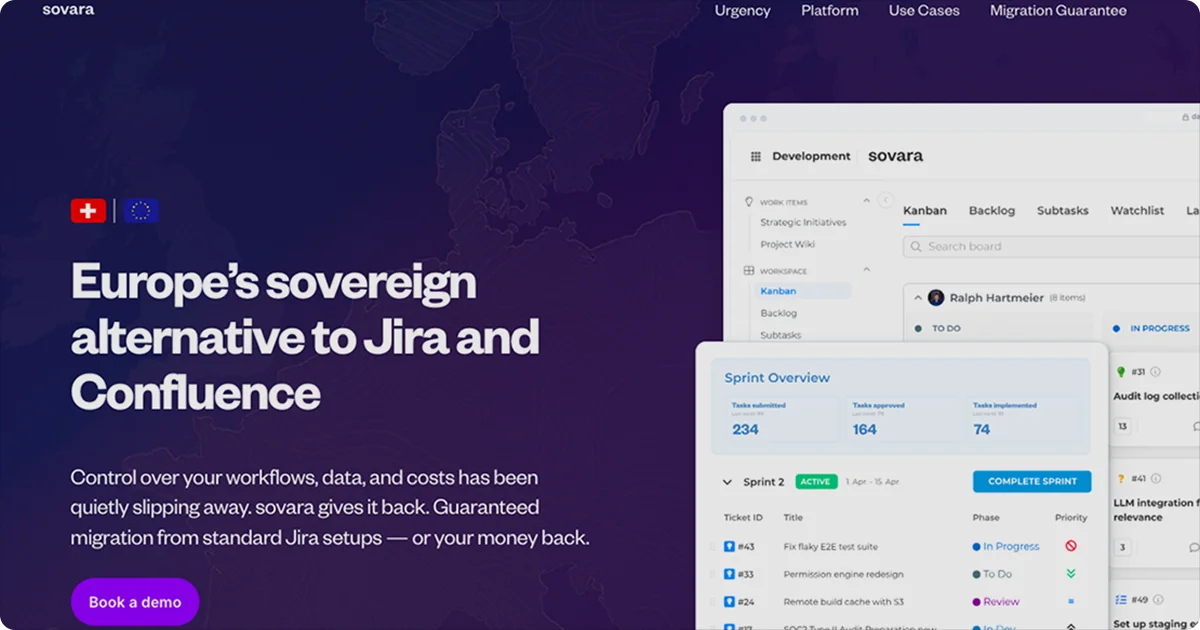
Developed and hosted within European jurisdiction, it keeps your data within your governed environment rather than routing it through vendor AI endpoints.
From a sovereignty standpoint, that means:
AI on your terms: Choose which AI operates within your environment: your own instance or a governed hosted alternative. Model updates happen on your schedule, not the vendor's.
Data governance by design: Deploy on sovereign EU cloud or on your own infrastructure. Either way, you set the rules for data access, storage, and workflow behavior.
Enterprise-grade security: Rely on SSO, GDPR alignment, and full audit logs as standard.
Interoperable architecture: Connect sovara to your existing tools via standard APIs, so you avoid creating new dependencies over time.
Moving from Jira, Confluence, or other platforms is supported through a structured migration process, so the transition doesn't interrupt your day-to-day work.
Not sure where your biggest exposure is? sovara's Digital Sovereignty Assessment helps you map your current setup and identify where sovereignty gaps are most critical.
Book a demo to see how rready and sovara handle AI sovereignty in practice.
FAQ
Is the EU AI Act only relevant to AI developers?
No. Organizations that deploy third-party AI tools also carry compliance responsibilities, particularly when those tools influence decisions about people, such as hiring or performance. If your organization uses AI to support decisions about people (in hiring, performance management, or access control), it's worth checking where that use case falls under the Act's risk categories.
Does pursuing sovereign AI mean we can't use tools like ChatGPT or Copilot?
Not necessarily. Sovereign AI is about governance, not prohibition. You can use public AI tools and still maintain sovereignty, as long as you have clear policies on what data employees can share, visibility into how those tools are being used, and alternatives in place for sensitive workloads.
Does GDPR compliance automatically mean AI sovereignty?
GDPR governs data protection, not AI governance. An AI system can meet every GDPR requirement and still give you no visibility into model behavior, training data use, or the way outputs are produced. The EU AI Act exists precisely to fill that gap.

Read more

Atlassian Data Center End of Life: Migrate, stay or leave
Atlassian Data Center EOL lands March 28, 2029. See the verified timeline, what's in scope, the licensing math, and the three destinations now open to you.

European Jira & Confluence Alternatives (2026)
6 European alternatives to Jira and Confluence for 2026, ranked and compared on sovereignty, AI, migration tooling, and real pricing.

You didn’t adopt Jira. You built an Operating System.
Atlassian Data Center ends in 2029. But migration doesn’t start with a data export. It starts with understanding what you’ve built over the years.