What is digital sovereignty and why does it matter in 2026?
Discover what digital sovereignty is & learn how you can regain control over your data, systems, and infrastructure to reduce risk and stay compliant.


Digital sovereignty is the ability to control your digital environment, including your data, your systems, and your governance frameworks.
In 2026, that control is under immense pressure, mainly because digital infrastructure is increasingly concentrated in the hands of a few global providers.
In fact, US hyperscalers now control more than 70% of the European Union cloud market, raising concerns about dependency, jurisdiction, and long-term resilience.
Digital sovereignty aims to reduce this dependency by helping you regain control in a landscape where rules, access, and risks aren’t always yours to define.
To understand why this matters for enterprise IT and how to move toward a more sovereign setup, this guide breaks down the key concepts, risks, and practical steps.
Key takeaways
Digital sovereignty means control over your digital environment
It gives you authority over your data, systems, and their governance, without requiring full independence from global providers.It goes beyond data sovereignty
Data sovereignty focuses on data, while digital sovereignty covers infrastructure, operations, and legal control across your entire stack.Rising risks make it a business priority
Regulatory pressure, vendor lock-in, and geopolitical tensions are increasing the need for control, resilience, and compliance.It delivers real business benefits
Digital sovereignty improves resilience, simplifies compliance, enables innovation, and builds trust with stakeholders.Start where control matters most
Work platforms are a practical starting point, and solutions like sovara help you regain control over workflows, data, and system evolution without losing flexibility.
What is digital sovereignty? Key concepts and dimensions
Digital sovereignty is the control over how your digital systems operate, including where they run, who controls them, and which laws apply.
This doesn’t require pursuing complete independence or cutting ties with global providers.
It’s solely about maintaining decision-making power so you understand what you depend on, recognize the trade-offs, and avoid getting locked into systems you can’t control.
What are the pillars of digital sovereignty?
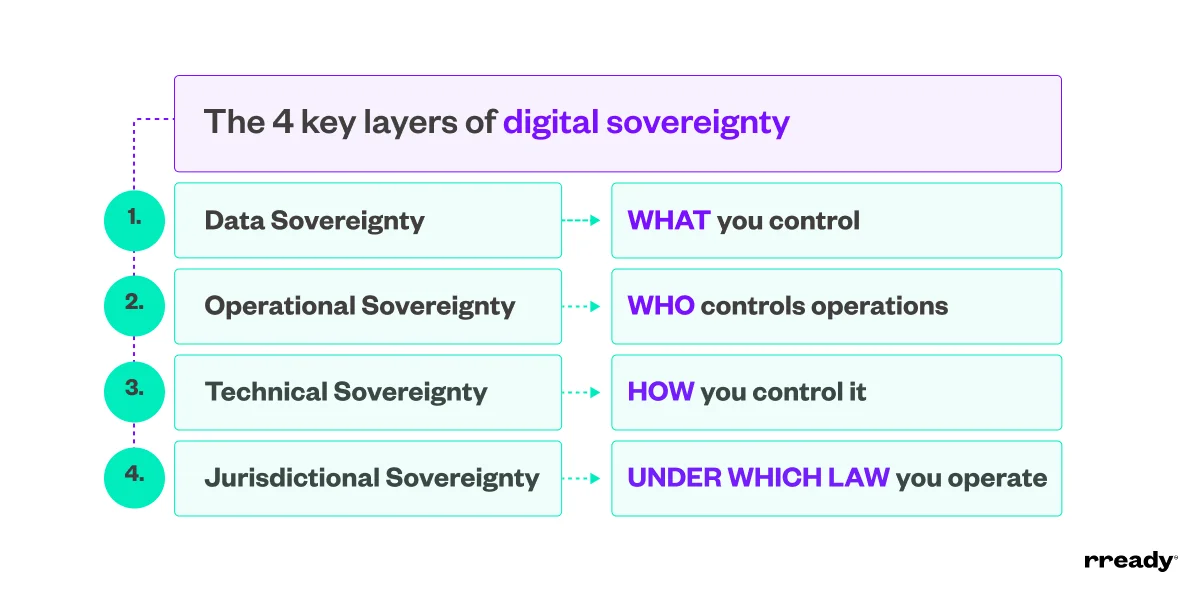
Digital sovereignty is built on a set of core pillars that define where control exists and how it can be enforced in practice:
Data sovereignty: Data remains under your control, allowing you to define where it resides, how it’s stored and processed, who can access it, and how it’s transferred or deleted.
Operational sovereignty: Organizations retain control over who operates and maintains systems, ensuring that critical workflows can continue without relying on external providers.
Technical sovereignty: Systems are designed with open architecture and control mechanisms that allow you to integrate, modify, and evolve your technology without being locked in.
Jurisdictional sovereignty: Your digital environment operates under the legal frameworks you choose, with safeguards against external legal access or conflicting regulations.
Who should be thinking about digital sovereignty?
Everyone who relies on digital systems should be thinking about digital sovereignty, including:
Governments and public institutions: Governments rely on digital sovereignty to maintain control over national infrastructure, enforce regulations, and ensure the continuity and security of public services.
Organizations and enterprises: Organizations are affected through their dependencies on hardware, software, cloud services, and external providers, which determine the amount of control they retain over data, operations, and risk exposure.
Regulated industries: Sectors such as healthcare, finance, energy, and telecommunications depend on digital sovereignty to meet strict compliance requirements while protecting critical data and infrastructure.
Multinational companies: Global organizations use sovereignty frameworks to balance centralized systems with local regulations, ensuring consistency without losing compliance across jurisdictions.
Individuals: Individuals rely on digital sovereignty to control their personal data, manage their digital identity, and protect how their information is collected, processed, and shared.
What is the difference between data sovereignty and digital sovereignty?
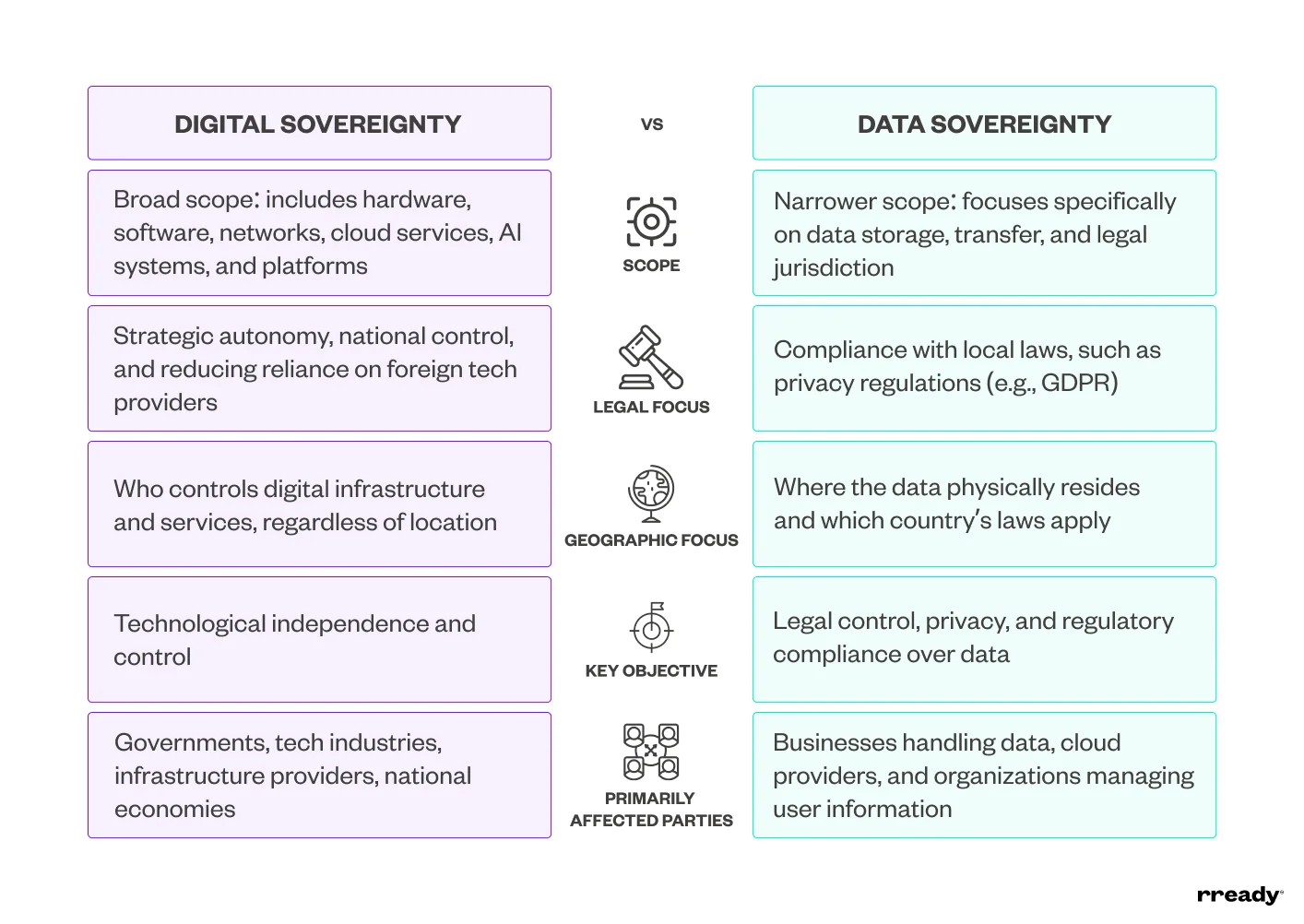
The main difference between data sovereignty and digital sovereignty is the scope.
Data sovereignty focuses on data, addressing its storage, processing, and legal governance.
Digital sovereignty goes further by covering the systems that handle that data, including infrastructure, software, operations, and the rules that govern them.
In simple terms, data sovereignty is a part of digital sovereignty, not a separate concept.
Why digital sovereignty matters now: 4 core drivers
Digital sovereignty matters now more than ever because digital systems have become critical to the way organizations operate, while the risks around control, compliance, and continuity have grown significantly.
Here are four key reasons digital sovereignty is now a business priority, not just a technical consideration.
1. Regulatory and legal risks are increasing
Regulatory pressure is intensifying across regions, especially in Europe.
Frameworks such as GDPR, NIS2, and DORA are raising the bar for how organizations manage data, security, and operational resilience. At the same time, legal conflicts between jurisdictions are becoming harder to ignore.
Under laws like the US CLOUD Act, US authorities can compel US-based cloud providers to hand over data, regardless of where that data is physically stored.
For organizations operating in regulated environments, this creates uncertainty around compliance and control.
2. Control over digital systems is shifting outward
Many organizations assume they control their systems, data, and operations.
In practice, that control has been steadily moving outward to external platforms and providers.
This shows up in subtle but critical ways:
Data residency is fixed, unclear, or difficult to verify.
Infrastructure is hosted outside your jurisdiction and control.
System behavior is defined by vendors rather than your internal teams.
Over time, this limits your ability to govern access, adapt workflows, and respond to change.
3. Vendor lock-in is becoming a strategic risk
Vendor lock-in was once just a technical limitation. Now, it’s a business risk.
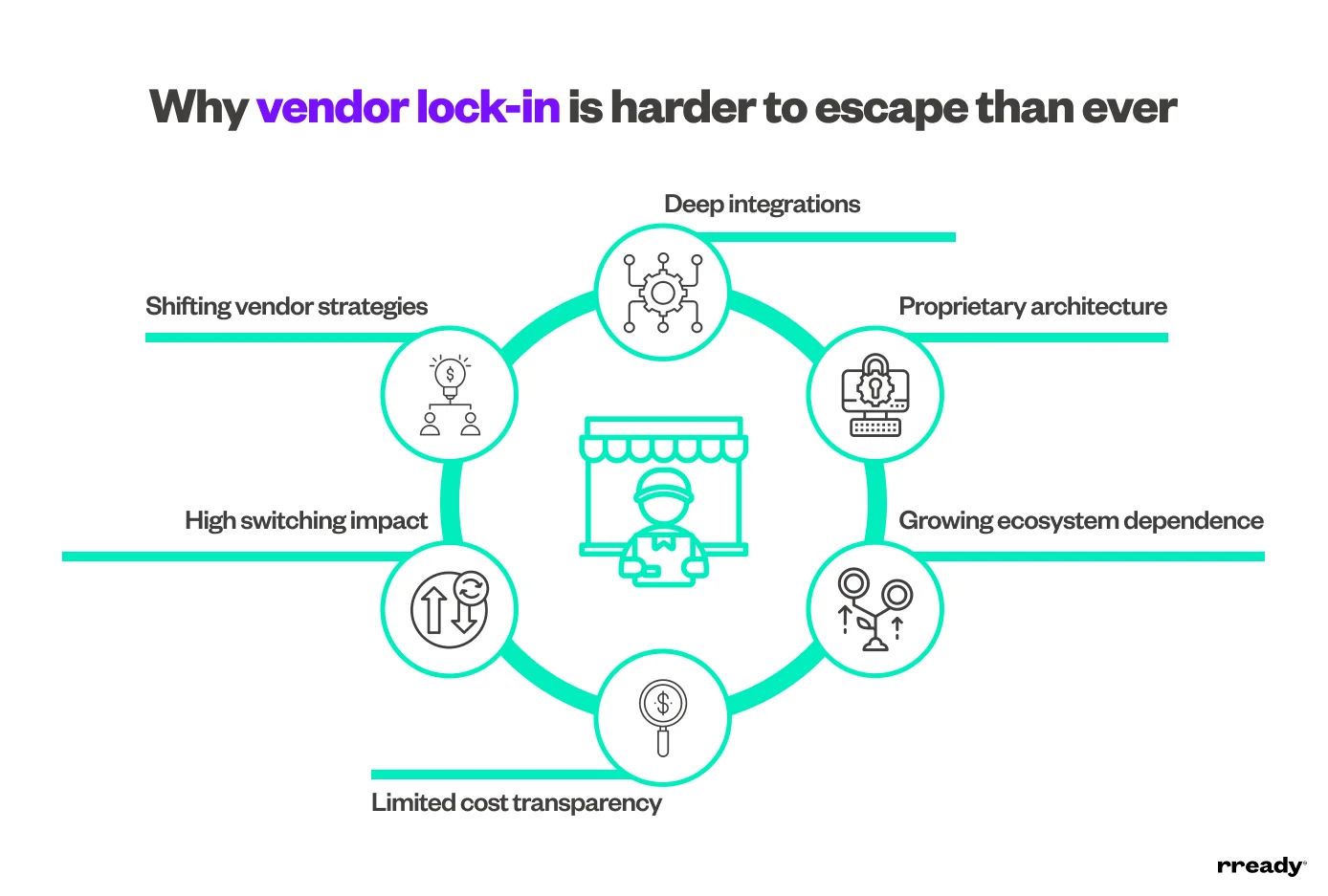
Organizations are finding it harder to move away from dominant platforms for several reasons:
Integrations are deeply embedded, making migration complex and time-consuming.
Architectures rely on proprietary systems that limit interoperability.
Dependencies on vendor ecosystems continue to grow over time.
Pricing models are opaque, with limited visibility into cost drivers.
Switching requires significant effort, risk, and operational disruption.
In addition, shifts in vendor strategy require organizations to adapt their plans, especially as more platforms move toward cloud-first models.
4. Geopolitical and cyber risks are accelerating
Digital infrastructure is no longer neutral. It is shaped by geopolitics, regulation, and global competition.
This is evident in the 48% rise in cyber incidents in 2024, driven in part by growing geopolitical tensions.
At the same time, concerns are growing around dependency on foreign technology providers and the concentration of power in a small number of companies.
These risks go beyond security, affecting the organization’s:
Business continuity, especially during disruptions or geopolitical instability
Operational resilience and the ability to maintain control over critical systems
Regulatory compliance across different jurisdictions
Long-term strategic flexibility and independence
Why move toward digital sovereignty: 6 practical benefits
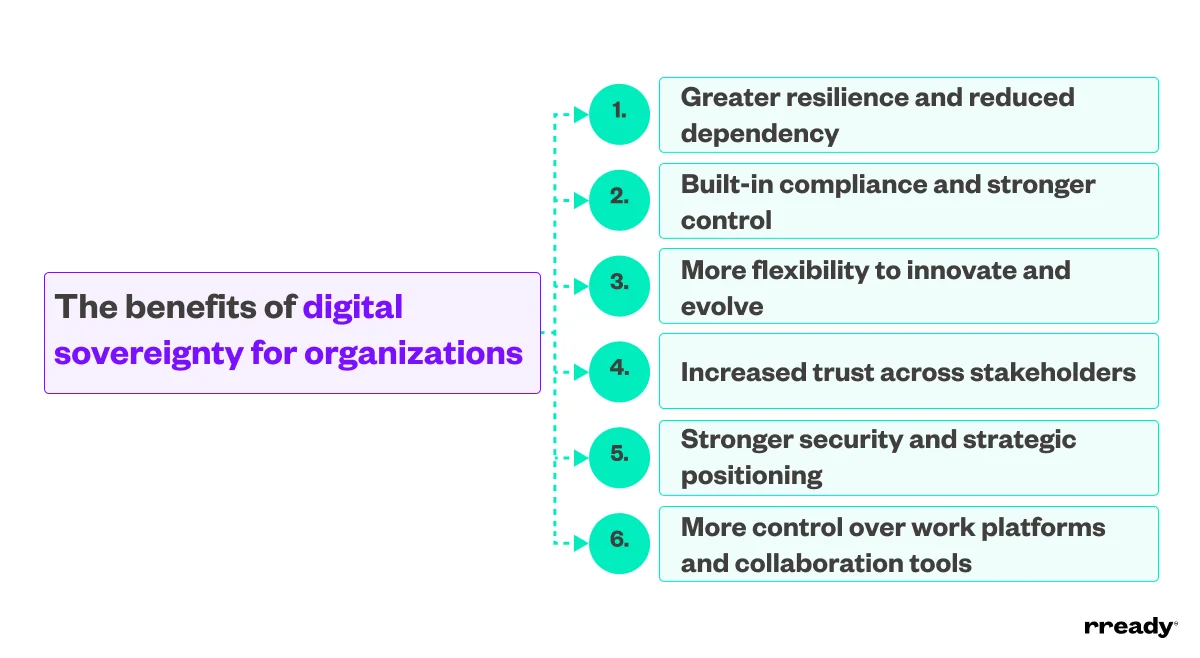
Digital sovereignty delivers practical, measurable benefits to organizations by giving them greater control over their systems, data, and long-term direction. These are the six advantages that matter most:
1. Greater resilience and reduced dependency
Reducing reliance on a single provider or tightly coupled ecosystem lowers exposure to disruption. It strengthens business continuity by removing single points of failure and giving you more flexibility in system deployment and management.
2. Built-in compliance and stronger control
When you define where data is stored, how it is processed, and who can access it, compliance becomes part of your architecture. This reduces the need for reactive fixes and makes it easier to stay aligned with evolving regulations, particularly when systems are built with compliance framework support for standards like GDPR, NIS2, and DORA from the outset.
3. More flexibility to innovate and evolve
With fewer constraints from proprietary systems, you can adopt new technologies such as cloud-native platforms and artificial intelligence (AI) without losing control. This creates space to experiment, iterate, and evolve your systems on your terms.
4. Increased trust across stakeholders
Clear control over data and systems builds confidence among customers, partners, and regulators. It shows that sensitive information is handled responsibly and in line with expected standards.
5. Stronger security and strategic positioning
As cyber threats and geopolitical pressures increase, digital sovereignty strengthens your ability to protect critical systems and maintain control during disruption. It supports long-term resilience at both operational and strategic levels.
6. More control over work platforms and collaboration tools
Sovereignty becomes especially relevant in day-to-day tools. When work platforms are fully owned and controlled by your organization, you avoid locking knowledge into proprietary systems, reduce reliance on external ecosystems, and maintain flexibility in team collaboration and scaling.
How to move toward digital sovereignty: 5 strategic steps
Moving toward digital sovereignty isn’t a one-time decision. It’s a structured process that builds control over time. Here are the five steps to get started:
Step 1: Map your dependencies
Most organizations underestimate the number of external systems their operations depend on.
That’s why you should first build a clear picture of what you rely on in your day-to-day operations. You can do so by looking at:
Which platforms and providers you use
Which systems support your core workflows
Which tools are difficult to replace or migrate
Step 2: Assess your risk exposure
Dependencies often introduce risks that are not immediately visible, particularly around legal exposure, compliance, and operational control.
To assess your risk exposure, your organization should examine the following:
Where your data is stored and which jurisdictions apply
Who can access your systems and under what conditions
Which regulations and compliance requirements you must meet
How dependent you are on external providers for critical operations
Step 3: Prioritize critical systems and data
Not everything needs to change at once. Focus your efforts where they matter most by starting with:
Mission-critical tools and workflows
Sensitive or regulated data
Systems with high switching costs
In many organizations, work platforms and collaboration tools are a natural starting point. They sit at the center of daily operations, store large amounts of institutional knowledge, and often carry significant dependency on external providers.
Step 4: Evaluate sovereign alternatives
With your priorities defined, the next step is to assess the support different solutions provide for digital sovereignty in practice.
Focus on the factors that determine the amount of control you retain across your systems:
Factor | What to look for |
Data control | Clear control over where data is stored, how it is processed, and who can access it |
Operational control | Ability to define workflows, system behavior, and access without vendor-imposed constraints |
Jurisdictional alignment | Infrastructure and operations aligned with your regulatory and legal requirements |
Cost transparency | Predictable pricing with transparent cost drivers and no unforeseen upgrades |
Flexibility and interoperability | Open APIs, modular architecture, and the ability to integrate with existing systems |
Control over system evolution | Freedom to adapt, extend, and evolve your systems without being locked into vendor roadmaps |
Step 5: Start small and scale deliberately
Digital sovereignty is best implemented step by step. A focused pilot helps you test assumptions without disrupting the entire organization.
Start with one team or department, ideally in an area where work is already structured through a platform, such as:
Project management
Software development
Issue tracking
Service delivery
Internal collaboration
Knowledge management
This allows you to validate performance, control, and usability in a real-world environment.
From there, expand gradually based on what works.
This approach reduces risk while building confidence and momentum for broader adoption.
Start moving toward digital sovereignty with sovara
Moving toward digital sovereignty isn’t simple, as it requires changes across architecture, governance, and long-term system management.
During this process, organizations often face:
Higher upfront investment and planning effort
More complex system design and governance requirements
The challenge of balancing control with flexibility
Despite these challenges, the direction is clear. The question isn’t whether to move toward digital sovereignty, but where to begin.
For many organizations, the most effective place to start is where work actually happens.
Currently, day-to-day work is often managed through platforms like Jira and Confluence, where workflows, documentation, and decisions are centralized. However, these platforms aren’t designed with sovereignty in mind, which makes them incompatible with strict requirements around data residency, access control, and system governance.
A sovereign alternative to consider, EU-built and hosted, is sovara.
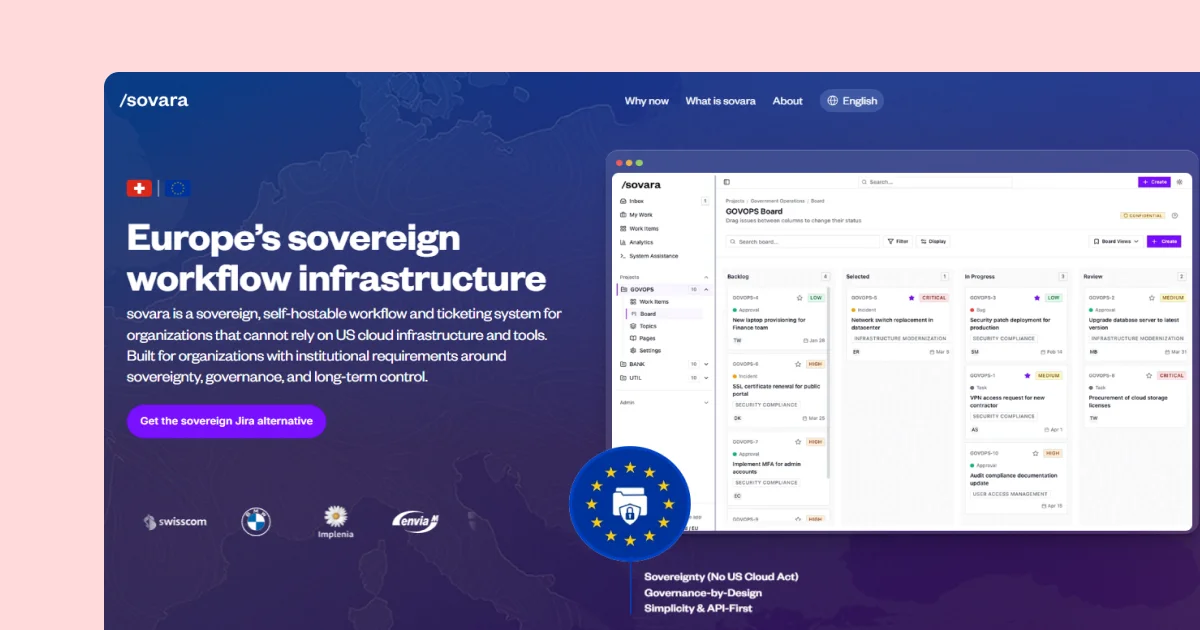
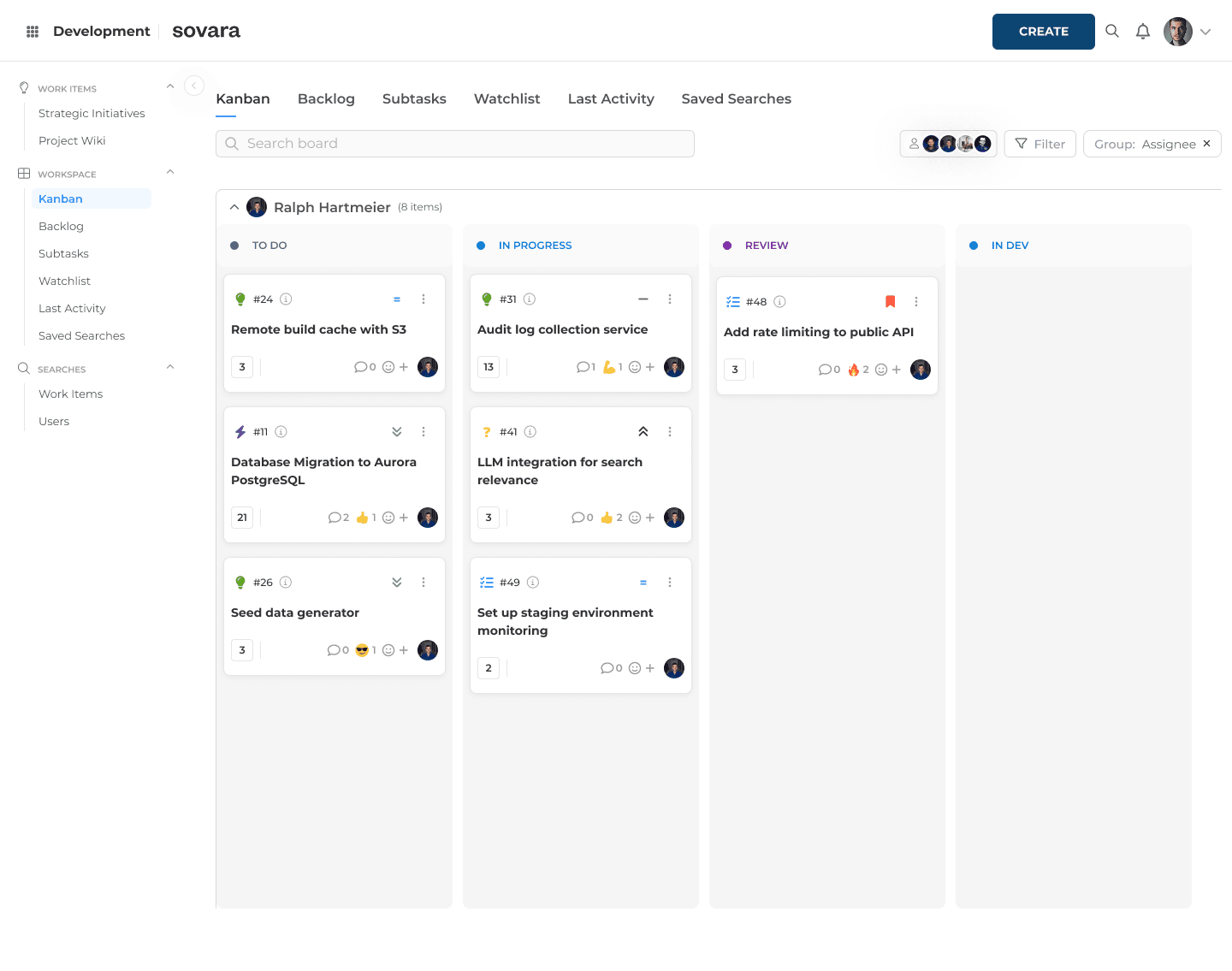
sovara is a sovereign work platform for enterprises and public organizations that want to maintain control without sacrificing flexibility.
It addresses the core challenges of digital sovereignty directly:
Sovereignty by design: sovara ensures that data is hosted and governed within European jurisdictions, with options for sovereign cloud and on-prem deployment.
Control over data and operations: Unequivocal control over where data is stored, how it is accessed, and how workflows behave across systems.
Predictable and transparent costs: Pricing structures are designed for long-term planning, with full visibility into cost drivers.
Modern, interoperable architecture: sovara enables seamless integration with existing systems through APIs and event-driven architecture, allowing data and workflows to move in a controlled way.
Future-ready system evolution: AI-native foundation allows organizations to define the use of AI, including the option to bring their own models or use hosted ones under controlled conditions.
Enterprise-grade security and governance: sovara provides structured access control, auditability, and compliance support through features such as SSO, GDPR alignment, and full audit logs.
sovara also supports structured migration from existing platforms, allowing you to transition critical workflows and data without disrupting operations.
Book a demo with our team to take the first step toward digital sovereignty and see how sovara fits into your environment.
Read more

Shadow AI in approved software: what Atlassian Rovo shows
What exactly is shadow AI? Often an update to software you approved years ago. Using Jira Rovo as the example: what to check for your AI governance.

Atlassian Data Center End of Life: Migrate, stay or leave
Atlassian Data Center EOL lands March 28, 2029. See the verified timeline, what's in scope, the licensing math, and the three destinations now open to you.

European Jira & Confluence Alternatives (2026)
6 European alternatives to Jira and Confluence for 2026, ranked and compared on sovereignty, AI, migration tooling, and real pricing.