Leadership and Management Innovation [Link Between Them]
Explore the link between leadership and management innovation and learn how your behavior shapes change, adaptability, and performance across teams.


Organizations talk endlessly about innovation, yet many still manage work the same way they did decades ago. New tools and strategies help, but they don’t explain why management innovation sticks in some companies and stalls in others.
The main difference is leadership.
Management innovation, which is closely linked to innovation performance, is fundamentally a leadership challenge. Leadership behaviors determine whether new management practices emerge, take root, or quietly die. They shape what gets questioned, what gets tried, and what actually changes.
With this in mind, let’s take a closer look at the link between leadership and management innovation and what happens when leadership gets it right (or wrong).
Key takeaways
Management innovation changes how work gets done, not what gets produced
It focuses on rethinking leadership, decision-making, and coordination. Real impact comes from redesigning management processes like governance, authority, and information flow, not from small process tweaks or tools alone.Traditional management models limit speed, adaptability, and engagement
Layered approvals, rigid structures, and top-down control slow decisions and block insight. Management innovation removes these bottlenecks, enabling faster decisions, greater adaptability, and better outcomes, such as higher innovation velocity and stronger talent retention.Empowerment, incentives, and role-modeling are the critical levers
Management innovation thrives when leaders empower teams, align incentives with learning and collaboration, and model the behaviors they want to see. Leadership style matters most when listening and action are combined.
What is management innovation?
Management innovation is a type of organizational innovation that focuses on changing how work is managed. It refers to new ways of organizing, leading, coordinating, and governing work that break from traditional management approaches.
That’s why management innovation isn’t just incremental process optimization, and it isn’t limited to introducing new tools.
There has to be a real change in how people lead, decide, and work together.
In large organizations, this kind of change doesn’t happen through good intentions alone. It happens when the processes that guide everyday work are rethought and redesigned.
That can take many forms, including:
New decision-making models
Agile or network-based structures
Open and cross-functional governance
What all these forms share is a shift in how authority, responsibility, and information flow through the organization.
Why management innovation matters
Traditional management models weren’t designed for today’s reality where speed, complexity, and knowledge-based work define how organizations operate.
Research is clear:
Layered approvals slow decisions down.
Rigid structures make it harder to adapt.
When insight lives across the organization, top-down control becomes a bottleneck.
Management innovation helps remove those limits.
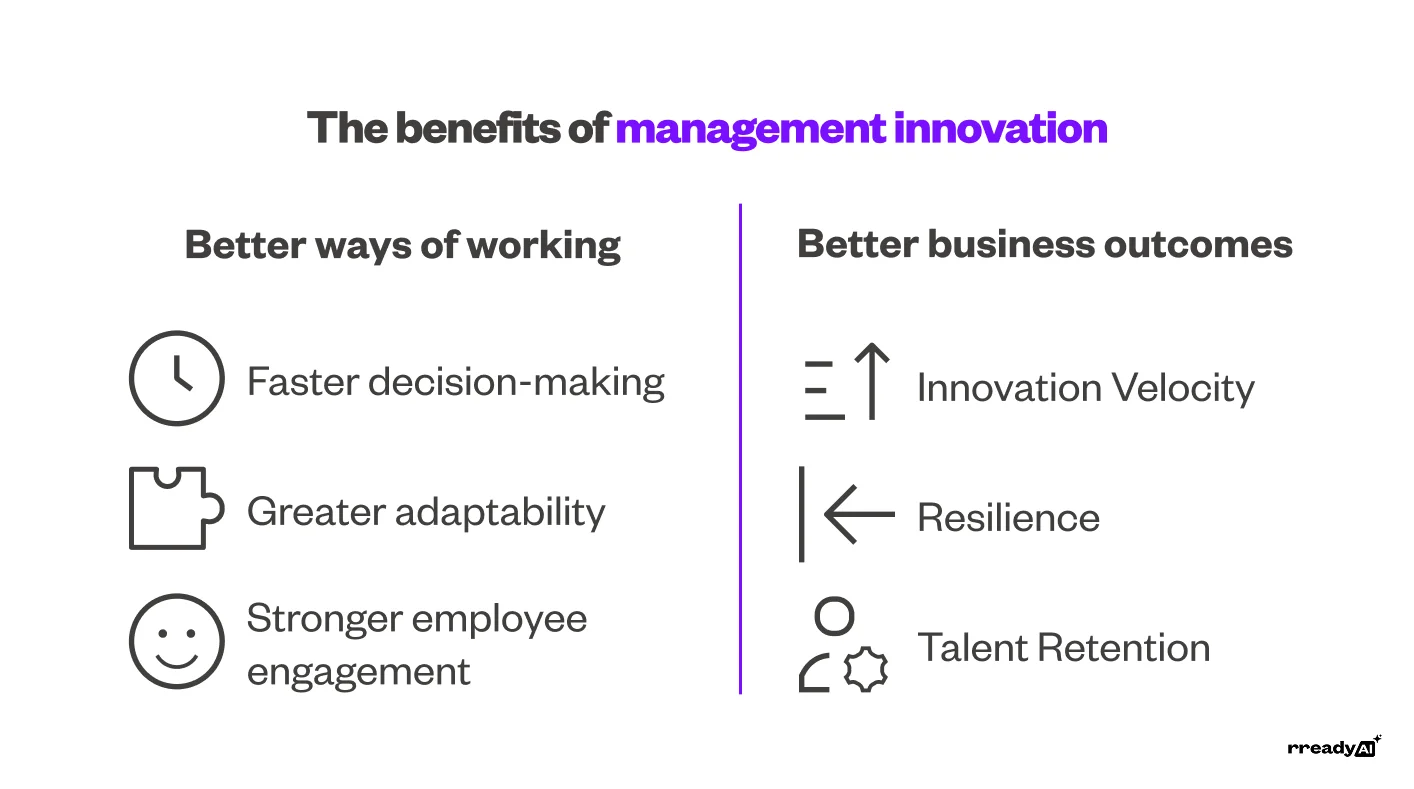
By rethinking how decisions are made, how authority is distributed, and how people contribute, organizations unlock faster decision-making, greater adaptability, and stronger employee engagement.
But the result isn’t just better ways of working. A positive change can also be seen in business outcomes like innovation velocity, resilience, and talent retention.
Leadership and management innovation: How leaders enable or block change
The success of management innovation relies on having the right conditions:
Problems worth solving
The willingness to challenge long-held assumptions
Systems that work together rather than in isolation
Commitment to keep improving over time
And most of these are shaped by leadership.
Here are four main ways in which leadership enables management innovation or blocks it before it ever has a chance to take hold.
1. Giving permission to challenge existing management models
Meaningful management innovation takes more than a clever idea; it takes courage to question how power, decisions, and responsibility are structured.
Challenging existing management models can feel risky, especially in organizations where long-standing practices are treated as proven truths rather than assumptions worth revisiting.
People hesitate because management orthodoxies are deeply ingrained. These include:
Change must start at the top.
It takes a crisis to provoke change.
Big companies need strong, centralized leaders.
These beliefs often go unquestioned because they sound practical and feel safe. But over time, they narrow what people believe is even possible.
This is where leadership makes the difference.
Leaders send clear signals, whether intentionally or not, about whether questioning “how things are done” is welcome. The contrast between enabling and blocking management innovation often comes down to a few clear leadership behaviors:
When leadership helps | When leadership hinders |
Publicly challenges legacy assumptions, not just outcomes | Defends existing structures because “they’ve always worked” |
Encourages teams to question hierarchies, approval chains, and ownership models | Centralizes authority and decision-making at the top |
Treats management practices as choices, not fixed rules | Treats existing processes as untouchable |
Creates space for debate without waiting for a crisis | Frames management innovation as disruptive or unsafe |
Signals that questioning the system is part of the job | Signals that challenging the system comes with personal risk |
When leaders loosen the grip of precedent, they give their team permission to imagine better ways of working. Without that permission, management innovation rarely gets past the idea stage, no matter how strong the case for change may be.
2. Shifting from control to empowerment
There’s a common misconception that strong leadership means tight control. Clear direction, firm decisions, everything running through the top.
In reality, the opposite is often true.
The most effective leaders don’t concentrate power; they multiply it. They enable others to take ownership, make decisions, and lead change themselves.
This shift matters because many businesses thrive when authority is distributed. New ways of managing work rarely emerge from a single office or role. They surface when people closest to the work are trusted to rethink how it gets done and are given the space to act on those insights.
Leadership behavior plays a direct role here. The table below illustrates how:
When leadership empowers | When leadership controls |
Distributes decision-making authority | Centralizes decisions at the top |
Encourages teams to redesign how work happens | Preserves existing workflows and roles |
Trusts employees to lead change | Requires approval for even small experiments or changes |
Uses dialogue and coaching to guide action | Relies on rules, oversight, and enforcement |
Builds leadership capability across levels | Treats leadership as a position, not a practice |
At its core, empowerment is about redefining leadership itself. Leadership should include the ability to increase the sense of power in others, not an exercise of power.
Organizations that embrace this idea, regardless of their size, show that coordination and innovation don’t require heavy hierarchy. They require shared purpose, clear principles, and trust.
3. Aligning incentives with innovative management behaviors
What gets reinforced gets repeated. And this is where management innovation often succeeds or fails.
When a team finds a better way to run a workflow, automate a manual process with AI, or simplify a complex approval chain, the payoff is rarely immediate or directly measurable.
That’s why, in most organizations, people aren’t explicitly rewarded for improving how the system works. More often, the reward is indirect: less friction, less wasted time, and more capacity to focus on higher-value work.
But leadership still plays a decisive role in whether these behaviors take hold or fade away.
Even without monetary incentives, leaders send powerful signals through what they notice, support, and protect:
When leadership supports management innovation | When leadership reinforces the status quo |
Acknowledges and highlights improvements in how work is organized and executed | Focuses exclusively on output, efficiency, and short-term delivery |
Makes time and space for teams to rethink processes, not just deliver outputs | Treats process improvement as “extra” work rather than core work |
Treats experimentation and learning as legitimate parts of the job | Discourages changes that temporarily slow execution |
Protects teams that invest effort in improving systems, even when results are incremental | Signals that improving how things run is less important than keeping things running |
Aligning incentives in this context doesn't mean introducing new bonus schemes or formal reward structures but rather broadening what leadership pays attention to and values. This way, innovative management behaviors become a part of the job, not an exception.
4. Role-modeling the behaviors they want to see
The actions of leaders are the most visible signals in any organization. Long before a new framework is implemented, people watch how leaders behave and take their cues from that.
When leaders collaborate openly, invite ideas, and explain how and why decisions are made, management innovation gains legitimacy. When they don’t, no framework, tool, or methodology can compensate.
How leadership and management innovation work together: 5 real-world examples
In the most visible cases, management innovation is the result of leaders deliberately rethinking how their organizations are managed.
The five examples below show how leadership choices at major organizations reshaped management models and what those shifts made possible.
1. General Motors: Separating control from execution
Faced with chaos at scale, the leadership at General Motors, most notably Alfred P. Sloan Jr., introduced a divisionalized structure.
Strategic control stayed centralized, while operational decisions moved closer to the business, giving division leaders real authority over day-to-day execution.
This leadership-driven shift allowed General Motors to scale without losing accountability and ultimately overtake Ford as the world’s largest carmaker.
2. Visa: Leadership as system design
Dee Hock rejected traditional hierarchy altogether when building Visa.
Instead, he designed a self-organizing, distributed governance model that balanced collaboration and competition.
Leadership focused on defining clear governing principles and coordinating how participants worked together, rather than controlling decisions through hierarchy. This helped create a system flexible enough to scale globally and endure.
3. Whirlpool: Making innovation everyone’s job
Frustrated by low levels of brand loyalty, Dave Whitwam, Whirlpool’s CEO at the time, set a clear mandate: innovation from everyone, everywhere.
Leadership backed it up by redesigning incentives, capital allocation, governance, and leadership development.
The result was a sustained management innovation program that turned innovation into a core management capability and added over $500 million per year in revenue by 2007.
4. Whole Foods: Shifting from control to community
Whole Foods’s founder, John Mackey, reshaped management around small, autonomous teams, radical transparency, and shared accountability.
Leadership moved from directing work to enabling communities, creating a management system that drove engagement, trust, and long-term performance in a notoriously competitive industry.
5. Toyota: Leaders creating leaders
Toyota’s leadership institutionalized a belief that frontline employees are problem solvers, not just operators.
By embedding this principle into everyday management practices, Toyota enabled these employees to improve processes as part of their daily work, unlocking continuous improvement at scale.
Toyota’s competitors struggled to replicate this approach for decades because it required leaders to relinquish control, redesign management processes, and consistently trust employee judgment, which are changes that counter traditional management models.
Turning leadership intent into everyday practice
When leadership and management innovation are aligned, the remaining challenge is scale: making those behaviors repeatable, visible, and durable across the organization.
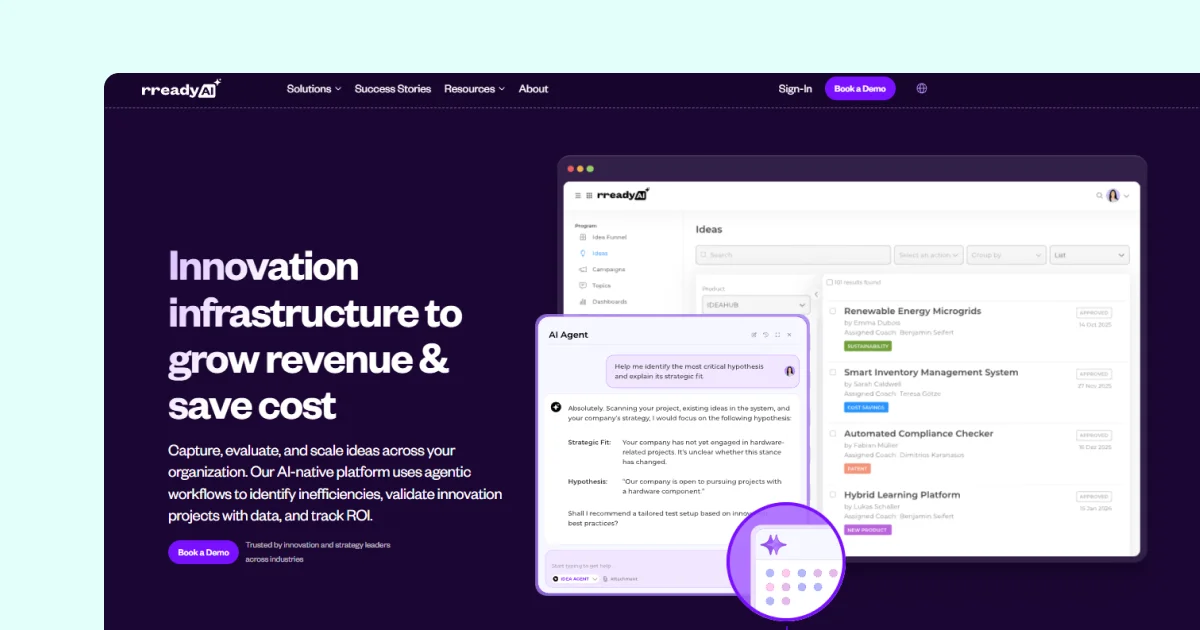
That’s where rready can help.
This innovation management platform supports leaders in continuously improving how they manage and operate. When those improvements work in practice, they become the default reference for the organization, naturally cascading into everyday practice. This is made possible through:
Open participation by design: By democratizing innovation, rready makes it clear that ideas aren’t reserved for a select few. Anyone can contribute, comment, and build on ideas, signaling that questioning how work gets done is not only allowed but expected.
Ownership where the work happens: With the KICKBOX Intrapreneurship Program, ownership moves closer to the people doing the work. Employees can take ideas from early insight to tested solutions, while leaders stay involved as coaches, not gatekeepers.
Visible contribution with meaningful rewards: rready makes contribution visible. Leaders can identify and reward the most active innovators, reinforcing learning, experimentation, and cross-functional effort.
Leadership in the open: Leaders don’t disappear into dashboards. They can engage directly: commenting on ideas, giving feedback, and encouraging teams in real time.
From idea sourcing to execution, rready helps leadership and management innovation move in sync. Not as a one-off initiative, but as a repeatable, scalable way of working, built around trust, transparency, and shared ownership.
Sign up for a detailed rready demo today to see how leadership and management innovation can come together in your organization.

Read more

8 idea management software benefits [Fully explained]
Discover the idea management software benefits that help you capture ideas, improve collaboration, and turn employee input into real business impact.

9 idea generation techniques businesses should use in 2026
Learn the best idea generation techniques to help you spark creativity, structure thinking, and turn ideas into actionable outcomes for your team.

Financial vs. Non-financial Incentives in Innovation
Explore the role of financial vs non-financial incentives in innovation and learn how you can motivate employees to share ideas and stay engaged.