
Turning idea management into measurably better
customer experiences
User Since
2015
Products used
Idea Management

About Swisscom
Sector
Telecommunications & IT-provider
Employees
19'100+
Headquarters
Worblaufen, Switzerland
Revenue
CHF 11.11 billion
Swisscom is one of the most well-known and most trusted brands across Switzerland and beyond, taking pride in delivering premium customer experiences. It was recently rated the strongest telecoms brand, and the third strongest international brand in the world.
Idea management on the frontline
Frontline employees understand better than anyone what truly matters to customers; and where internal processes fall short. Every day, they see which workflows are time-consuming, where expectations remain unmet, and where products or services could be improved from the customer's perspective. Yet in many organizations, this insight remains underutilized. Customer-facing teams hold practical, experience-based knowledge that is invaluable for improving the customer journey; but without the right structures, much of this potential is lost. For frontline observations to create real impact, they must be systematically captured, evaluated, and translated into concrete actions. Only when these insights become implementable improvements do processes become more efficient, solutions faster, and customer experiences more consistent.
Many companies describe themselves as customer-centric. They have feedback channels, defined roles, and analytical tools in place. On paper, the structures for improvement exist. In practice however, the potential often remains untapped. Heavy operational workloads, lack of practical expertise, missing or limited incentives, weak feedback and error cultures, and insufficient leadership commitment prevent frontline insights from being leveraged effectively. As a result, valuable knowledge is lost; and decisions risk drifting away from real customer needs.
This is exactly where structured idea management can make the difference. It provides a clear framework to capture frontline insights with low barriers, prioritize them transparently, and develop them systematically. In doing so, customer feedback is transformed into measurable improvements. In both processes and experience.
Removing barriers and creating the foundation for successful idea management
Effective idea management does not happen by accident. It requires consciously addressing structural, cultural, and operational obstacles.
01
Structural barriers
Lack of accessible processes and tools: Many organizations lack simple, low-threshold mechanisms for submitting ideas. Without easy-to-use formats and clear workflows, customer observations cannot be systematically captured or processed.
Organizational silos: Successful idea management depends on cross-functional collaboration. In reality, front and back office teams often operate in isolation, preventing customer insights to move smoothly through the organization.
Unclear responsibilities: Without clearly assigned ownership, ideas lose momentum. If contributing improvements is not seen as part of the frontline role, valuable impulses from daily customer interactions are missed.
Underused systems: Even when tools exist, they must be visible, intuitive, and supported by a clear follow-up process. Otherwise, they quickly become symbolic rather than effective.
Limited resources: Successful idea management requires time and attention. In high-pressure operational environments, structured reflection and improvement are often deprioritized in favor of day-to-day execution.
02
Cultural barriers
Beyond structures, culture determines whether employees actively contribute ideas.
Unclear incentives: When frontline employees are already overloaded, a common question arises: "What's in it for me?" If incentive systems are unclear, poorly communicated, or nonexistent, participation declines. Note: Have a look at the playbook "Incentives in Idea-and Innovation Management" – here
Weak error and feedback culture: In environments where mistakes are avoided rather than used for learning, psychological safety is limited. Employees hesitate to share improvement ideas openly.
Lack of visible appreciation: If ideas are rarely acknowledged or communicated transparently, employees assume their contributions do not matter - reducing motivation to engage again.
Limited transparency: When it remains unclear what happens after submission, trust in the system erodes. Feedback, status updates, and decision transparency are essential for long-term participation.
Hierarchical mindsets and insufficient leadership support: In strongly top-down organizations, employees often do not feel empowered to contribute. Visible endorsement from leadership is crucial to legitimize and encourage participation.
03
Operational barriers
Even with strong structures and culture, daily realities can hinder the idea management process.
Time pressure and competing priorities: If idea generation is not integrated into existing routines, it is perceived as an additional task - and quickly sidelined during peak workloads.
Lack of workflow integration: When idea submission is not embedded into existing systems (e.g., CRM tools), it feels disconnected from daily operations and requires extra effort.
Unclear evaluation criteria: Employees need clarity on what constitutes a strong idea. Without transparent criteria, frustration and disengagement increase.
Long decision cycles and delayed feedback: Slow evaluations signal low priority. Without timely responses, motivation drops.
Lack of data: Without structured analysis of recurring customer issues, there is no reliable basis for prioritizing ideas in a meaningful way. Potentially effective suggestions therefore compete with individual opinions or short-term assessments.
The success factors behind Swisscom’s approach
A
Clear roles, decentralized responsibility & strong communities
Swisscom has anchored idea management within its Lean strategy and corporate objectives related to efficiency, customer satisfaction, and cross-functional collaboration. On this foundation, a system was built that is centrally orchestrated but operates in a decentralized manner within daily team routines.
Clearly defined roles form the backbone:
Frontline employees identify customer needs and operational challenges.
Team leaders create space and time for reflection and idea discussion.
SPOCs (Single Points of Contact) promote Lean and improvement topics in daily operations.
Topic Owners guide ideas from submission through implementation.
Lean Community members with formal training in Lean management, ensure standards, exchange formats, and capability development.
This shared foundation ensures that ideas are not only heard but are systematically captured, evaluated, and driven forward.
In B2C, Business engineers take on a central evaluation role. They assess ideas, formulate impact hypotheses, and develop business cases. In doing so, they bring subject-matter depth and data-driven decision-making into the process. B2C also benefits greatly from its close proximity to the operational frontline: customer feedback becomes visible quickly, is prioritized, and translated into systematic improvements.
In B2B, so-called “Challengers” review and refine ideas within the team before official submission.
In addition, a cross-functional Lean Community, consisting of representatives from various business units, coordinates events such as "Lean Days", develops guidelines, monitors idea backlogs, and supports new Topic Owners.
B
Continuous improvement as part of the DNA
1. Leadership commitment
An idea management system suceeds only when continuous improvement is part of the company’s identity. This cultural buy-in must be tangible across all levels - from top management to team leadership, and individual departments.
At Swisscom, leadership visibly reinforces this principle. One example is the “CEO Lounge,” where successfully implemented ideas were presented to the CEO and recognized with a joint, in-person lunch.
Appreciation is embedded as an operational principle at Swisscom - regardless of whether an idea is ultimately implemented. At the B2B Customer Service department level, for instance, the Head of Department regularly takes the time to personally acknowledge active contributors, reinforcing engagement and ownership.
2. Appreciation, motivation & empowerment
At Swisscom, recognition is made visible across different areas, through formats such as “Lean Days”, featuring interactive elements like a “Hall of Fame” for successful ideas, a Lean quiz, idea challenges, and gamified activities. Personal thank-you letters add an additional human touch.
C
Structured processes, transparency &
data-driven governance
Submitted ideas follow a clearly defined and transparent process. Before formal submission, they are refined in a challenging process (within teams or Lean formats), strengthening problem understanding and improving the quality of proposals.
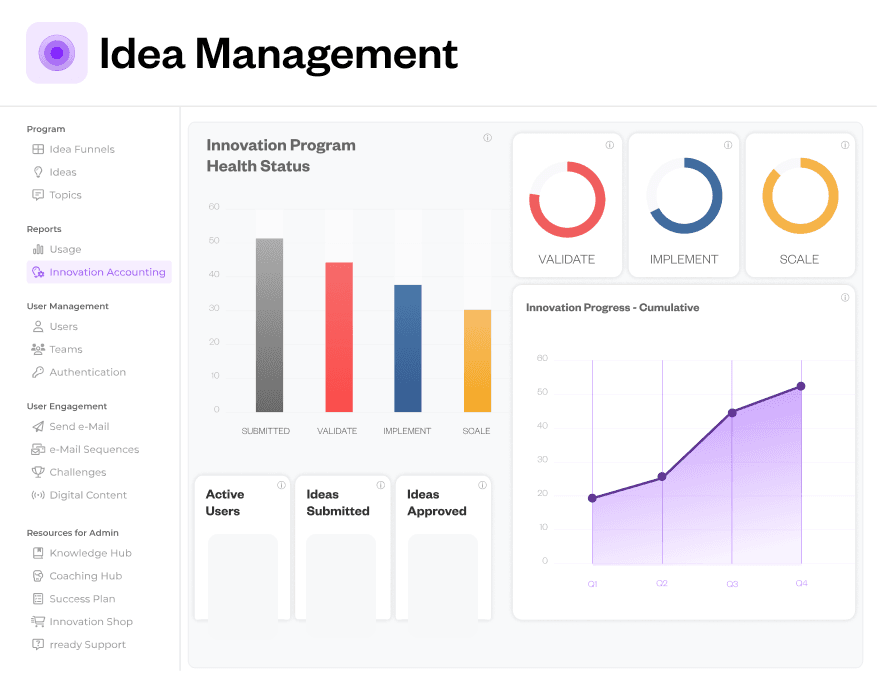
Impact measurement is a key steering instrument, particularly in B2C. Each idea includes a benefit hypothesis and is validated using data from the data warehouse (a central repository where concrete case numbers can be retrieved). Employees provide initial rough estimates, but the validated calculation is carried out by Business engineers, who quantify workload savings, direct and indirect costs, or potential sales effects. Ideas with greater financial impact potential are reviewed by dedicated committees and tracked as part of monthly reviews. This disciplined use of data sets realistic expectations, reduces misjudgments, and makes the contribution of idea management tangible. In B2B, the focus is more strongly placed on qualitative improvements and service quality; however, the tracking of quantitative benefits also plays a role.
Consistent follow-up is critical. Team leaders, SPOCs, Business engineers, and Topic Owners actively remove obstacles and ensure progress through structured reviews and backlog discussions. Clear ownership prevents ideas from stalling. In some cases, tracking is integrated into specific roles: Service managers and SPOCs keep their topics on the radar as part of their daily business and use the idea management tooling as a component of regular process steering. This combination of structured follow-up and clear ownership contributes significantly to the high implementation effectiveness.
D
Enablement & capability building
In recent years, Swisscom has invested extensively in Lean training for employees across departments. Trained act as multipliers, embedding methodologies in their teams and driving improvement initiatives.
Business engineers receive specialized training to assess data and validate benefit hypotheses rigorously.

How rready strengthens
idea management at Swisscom
1.
IDEAHUB as the central platform
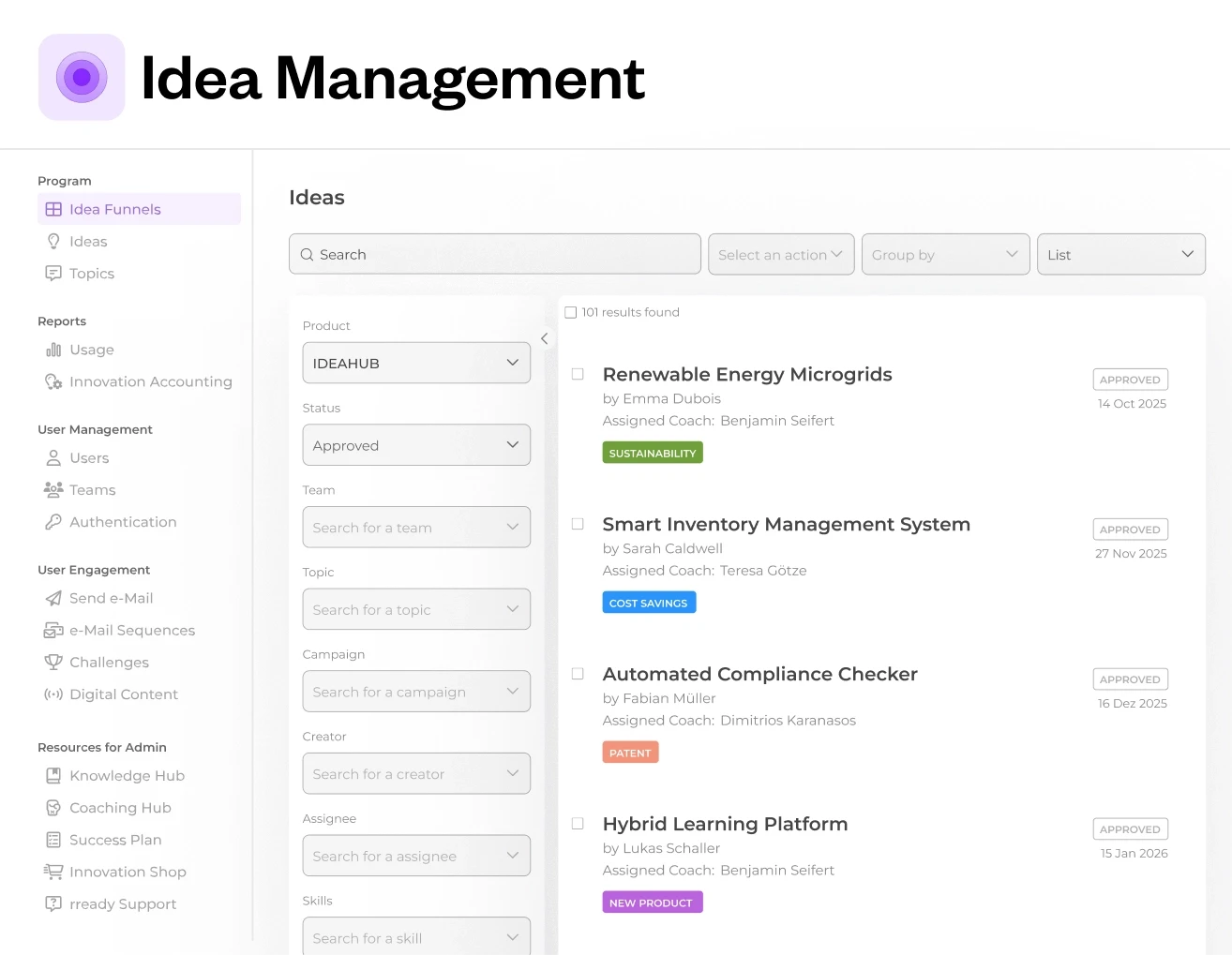
IDEAHUB - rready's established idea management tool - serves as the backbone of Swisscom's idea management process across B2B and B2C. The platform enables structured submission, evaluation, and prioritization of ideas while ensuring full transparency across the idea lifecycle. Through close collaboration, the idea management platform has been aligned with Swisscom's Lean philosophy and integrated seamlessly into existing systems via an API-first architecture. A modern, user-friendly interface lowers entry barriers and enables intuitive adoption among employees.
A key success factor are the AI functionalities of the tooling, supporting process automation, providing inspiration, identifying patterns, and detecting trends. AI makes connections between projects visible (for example, regarding relevant topics, market developments, or technologies), thereby reducing duplication and enabling synergies to be leveraged more effectively.
2.
Measurability & impact transparency
IDEAHUB enables precise tracking of participation and well-founded evaluation of the success and impact of ideas. Comprehensive reporting functions make it visible which ideas create the greatest value, where bottlenecks arise in the process, and how employee participation and implementation rates evolve over time.
The platform not only displays the number of submitted and implemented ideas per department, team, or even individual, but also analyzes process obstacles such as long response times from subject-matter experts, low implementation rates, or delays in specific processing steps.
This way, IDEAHUB creates an unprecedented level of transparency regarding performance, engagement, and value creation - enabling Swisscom to continuously optimize its idea management process based on measurable insights.
3.
Sparring partner & cultural transformation
Beyond technology, rready’s innovation experts support Swisscom through coaching, workshops, and methodological guidance, acting as sparring partners on equal footing. This collaboration strengthens long-term implementation capability.
Results
The impact of this integrated approach is tangible.
1.
Efficiency gains
Idea management at Swisscom makes a measurable contribution to efficiency. Many ideas lead to simplified workflows, reduced process steps, or automation - resulting in time and resource savings as well as workload reductions. Idea management has become a meaningful contributor to operational performance.
2.
Customer experience improvements
Idea management at Swisscom has already led to substantial improvements in customer service. In the areas of billing and correspondence, for example, 50% of all improvements originate directly from ideas submitted via the idea management platform.
Examples include self-service invoice management, installment payment options, and deadline extensions. The quality of customer correspondence has also been improved through standardized email templates. These enhancements improve clarity, speed, and transparency - significantly increasing customer satisfaction.
3.
Organizational impact
Frontline involvement generates more ideas grounded in daily reality, accelerating processing cycles and strengthening adaptability. Particularly valuable is the continuous development aspect: by systematically documenting, evaluating, and implementing improvements, Swisscom enhances its ability to respond flexibly to changing market demands.
4..
Cultural impact
Employees experience that their contributions and insights matter. This strengthens ownership, initiative, and engagement across the organization. This sense of participation strengthens identification, initiative, and engagement throughout the organization. A culture of continuous improvement emerges directly at the customer interface - where insights are generated, prioritized, and translated into action.
Conclusion
When customer knowledge gets lost in day-to-day operations, companies run the risk of making decisions that miss the real needs of their customers. This is precisely where idea management unfolds its strategic impact. It is far more than a tool or an isolated process - it is a lever for measurably better customer experiences, greater efficiency, and a sustainably embedded culture of improvement.
What makes the difference is the interplay of clear roles, strong leadership commitment, lived appreciation, data-driven governance, and a technological platform that creates transparency and enables integration. Only this combination transforms individual impulses into a structured and reliable improvement process.
Swisscom demonstrates this impressively: when employees at the customer interface are systematically empowered, customer insights are captured in a structured way, and their impact is consistently measured, a closed loop of continuous improvement emerges. The result is tangible efficiency gains, concrete optimizations along the customer journey, and an organization that acts with agility, learning capability, and consistent customer focus. In this way, idea management evolves from a buzzword into an effective practice - delivering sustainable impact on both performance and customer experience.