All voices
This article was originally published in German.
Innovation with a compass: Strategic idea management as the bridge between agility and focus
Johannes Walter explains how combining top-down strategy with bottom-up ideas enables organizations to innovate with both focus and agility.
Author
Johannes Walter

Introduction:
The end of the traditional suggestion box
In today’s VUCA world (Volatility, Uncertainty, Complexity, Ambiguity), the ability to continuously renew oneself is no longer an optional extra, but an existential necessity.
The key challenge for business leaders is no longer simply generating ideas, but channeling the creative energy of the workforce (bottom-up) in a way that not only supports but actively accelerates overarching corporate objectives (top-down). This article explores the tension between freedom and focus and illustrates how the so-called “countercurrent principle” can be transformed into a decisive competitive advantage.
The innovation paradox: Why freedom needs guardrails
Management literature often promotes the idea that innovation thrives best in the absence of constraints. In practice, however, organizational reality shows a different picture: total freedom frequently leads to "innovation entropy"- the inefficient dispersion of resources across projects that may be creative but generate no strategic market value or fail to support the core business.
A robust innovation strategy serves both as a filter and as a compass. It defines the space in which innovation should take place to secure long-term business success. Without such a framework, companies risk having their most capable people invest time and energy in dead ends. The consequence is often a “rejection culture ” that leads to frustration and a retreat into a purely rule-based, compliance-driven mindset.
The countercurrent principle: The symbiosis of top-down and bottom-up
One of the most effective ways to balance entrepreneurial discipline with creative initiative is through the countercurrent principle. It brings together leadership’s strategic perspective and employees’ operational knowledge.
Top-down: Setting strategic search fields
Leadership defines the themes or opportunity areas in which innovation is encouraged. These search fields may be based on megatrends, such as decarbonization or generative AI, or on concrete market developments. This does not restrict creativity. On the contrary, it removes the uncertainty that arises when everything seems possible but nothing is prioritized.
Bottom-up: Activating local expertise
Employees act as the company’s "sensors". They work with customers, systems, processes, and machinery every day. As a result, they can identify inefficiencies long before they are visible in management reports. Within the defined search fields, they develop concrete solutions. The decisive advantage is that these ideas are already pre-validated, as they have emerged within a strategically desired corridor.
A Practical example: From the maintenance shop floor to a global efficiency standard
A mid-sized mechanical engineering company provides a strong example. It defined “resource efficiency through digitalization” as one of its innovation priorities. During his day-to-day work, a service technician noticed that a large portion of machine downtime was caused by the manual documentation of wear parts.
Rather than simply flagging the issue, he developed an app-based scanning solution through the company’s internal idea management system. Because the process was structured, he received initial support in the form of time and budget to validate the concept.
The result: maintenance time dropped by 15 percent. What started as one technician’s observation eventually became part of the company’s global digital service portfolio.
Organizational ambidexterity: Leadership must be able to do both
A deeper analysis requires looking at organizational ambidexterity. Companies need to excel at two very different things at the same time:
Exploitation: improving what already exists through optimization and incremental innovation.
Exploration: discovering radically new approaches and opening up future business areas.
In my experience, the real challenge is not only structural separation, but managerial mindset. Leaders need a kind of "mental ambidexterity". They need to learn to act as cultural translators and determine how much controlled chaos efficiency can handle, and how much structure creativity actually needs.
This is why modern idea management practices must not isolate exploration in ivory towers. Instead, the "sandbox” (the protected space for new ideas) must be designed in such a way that it remains connected to the core business. Only then can we overcome the organization’s “immune system,” which naturally tends to preserve the status quo.
How are ideas captured, evaluated and prioritized in your organization?
Explore how a structured approach to idea management can generate a steady stream of relevant ideas.
Book a call
The tension of decentralization: Structure beats chaos
Empowerment and decentralized decision-making are essential for agility. But decentralization without coordination brings risks and quickly leads to fragmentation. Teams solve similar problems in parallel, develop isolated solutions, and compete for the same resources.
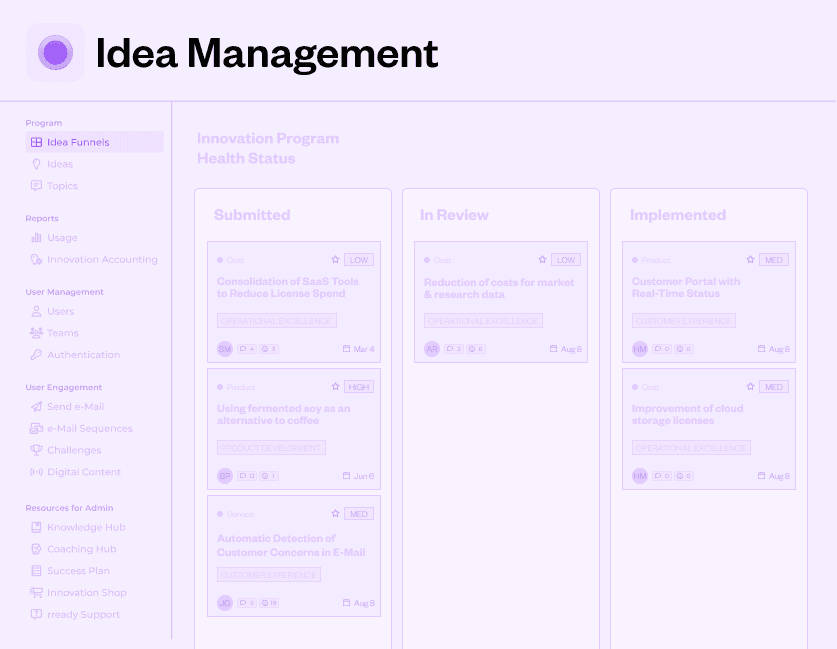
To minimize this friction, professional infrastructure matters. Platforms such as those provided by rready make it possible to capture decentralized idea flows in one place, evaluate them transparently, and support them with proven methods such as Lean Startup logic. This creates visibility across departments, enables synergies, and makes the “return on idea” measurable.
The cultural factor: Psychological safety and quality of feedback
No process works without the psychological dimension. People only share bold ideas when they feel safe enough to do so. That makes transparent communication essential. Rejection should never feel personal. It should be explained clearly, professionally, and in the context of strategic priorities. When people understand why an idea does not currently fit, rejection becomes less of a setback and more of a learning opportunity for the wider organization.
Info box: A 5 step checklist for strategic idea management
Define strategic search fields: Is it clearly communicated where innovation is expected and encouraged?
Create simple access points: Is there an easy-to-use platform that works across sites and hierarchy levels?
Provide time and resources: Do idea contributors have time and budgets to validate promising concepts?
Build structured feedback loops: Is there qualified feedback that also helps people learn and improve future ideas?
Check for ambidexterity: Are optimization successes valued just as much as lessons learned from ambitious projects that were stopped?
Conclusion: Innovation as the operating system for the future
Successful idea management is not a temporary program. It is part of how the organization functions. Real innovation power emerges where employee passion and commitment meets strategic clarity from leadership. Companies that manage to channel bottom-up momentum through top-down direction build organizations that are not only resilient in times of change, but capable of actively shaping what comes next.
About the author
Johannes Walter specializes in helping organizations modernize and digitalize their improvement processes. As the founder of JW Consulting, he works with companies and public sector organizations to unlock hidden potential through structured idea management and to build lasting cultures of innovation.
Before founding his consultancy, he served as Head of Corporate Idea Management at Liebherr. In this role, he led the global rollout of an idea and innovation management program for approximately 30,000 employees across 26 countries.