All voices
This article was originally published in German.
From idea push to idea pull
Andre Wermelinger explains that innovation fails not from a lack of ideas, but from overloaded systems, and advocates shifting to “idea pull” by reserving capacity to drive execution and impact.
Author
André Wermelinger

Many organizations invest heavily in innovation and continuous improvement. Ideas are collected, programs are launched, and employee participation is often encouraging. And yet, the overall impact frequently falls short of expectations: valuableideas remain stuck in queues, responsibilities are unclear, and enthusiasm gradually gives way to inertia. The issue is rarely a lack of ideas. More often, it is the absence of flow within the system.
Innovation and Continuous Improvement share the same engine: Value flow
Whether the focus is innovation or continuous improvement, the decisive factor is not the volume of ideas, but the organization’s ability to translate them into impact. Impact does not arise during brainstorming. It is created when an idea successfully progresses through the following stages:
This process is, in essence, another value stream within the company. And in most cases, it places simultaneous demands on the organization’s core value streams, meaning the resources and capacities required to deliver its primary products or services.
Value streams follow a simple operational rule: once a system approaches its load limit, every additional task will increase congestion, and that congestion accumulates in front of the bottleneck. In a production setting, the bottleneck may be a critical machine. In administrative processes, it is more likely to be a key team or individual. In factories and workshops, this buildup becomes visible in growing work-in-progress or in-process inventory. In office-based environments, by contrast, it is often far less visible and may only become apparent through analysis. In the worst case, it hides in overloaded inboxes.
This is the point where idea management turns into a paradox. The organization calls for more ideas, but in doing so adds even more work to a system that is already operating at or beyond capacity. A program intended to inspire participation can thenbecome a source of frustration and resistance.
The uncomfortable reality: Without dedicated capacity, idea management becomes a disruption
Innovation and idea management processes are often designed by people with a strong grasp of processes and Lean Management. They are usually familiar with concepts such as value streams, (Theory of constraints (TOC), push versus pull). And yet, despite this understanding, organizations often disregard these principles and, usually unintentionally, build push systems that place additional strain on the business rather than support it.
Even when launching new continuous improvement programs, I regularly hear the same proposal: “We should start with a major company-wide campaign, with top management calling on everyone to participate.”
Such campaigns do indeed create momentum across the organization and can generate strong levels of motivation and participation. But this is often followed by disillusionment.
The large volume of ideas cannot be assessed quickly enough or with sufficient technical depth. Many idea management programs already struggle just to establish clarity and prioritize properly. And by the time implementation is required, the real constraint becomes obvious: the key resources are already fully occupied, often beyond their practical limit. No one has been waiting for the next idea, and even if it is a good one, it struggles to compete with immediate operational pressures.
In the short term, this type of prioritization may even appear commercially sound and rational. In the medium to long term, however, it creates debt, usually technical debt or process debt, but also product debt and many other forms (e.g. technical debt, process debt, social debt, etc.).
The paradigm shift: From idea push to idea pull
A pull-based approach to idea management may sound simple, but it changes everything. It starts with one clear leadership decision:
We will reliably reserve capacity for continuous improvement and innovation.
Once this commitment is made, the dynamic shifts fundamentally. The organization no longer approaches employees asking for more and more ideas. Instead, those responsible come with a genuine opening in their calendars and ask:
“We now have capacity. What should we improve next? Where is the greatest potential for optimization?”
That is idea pull. And it changes the quality of the entire process through three specific consequences:
Ideas become more concrete
Because they are shaped around a real business need and a real implementation window. Broad wishes become actionable proposals.
Decisions are made faster
Because choices are made in the context of an upcoming cycle, not deferred to some undefined future point.
Implementation becomes visible
Visible implementation is what sustains engagement. For the person submitting the idea, it creates recognition, pride and renewed motivation.
More mature organizational models offer explicit guidance on the level of capacity that should be allocated. SAFe (Scaled Agile Framework), for example, allocates 20% of available development capacity to innovation and continuous improvement. This is a substantial allocation, and one that I have not yet encountered in practice in any company. On the contrary, both innovation and continuous improvement often struggle because the existing value streams are already fully overloaded. For that reason, I take a pragmatic starting point in real-world settings. Even a credible allocation of 5% of development capacity to continuous improvement can, in many cases, already be a solid starting point from which a program can begin to generate meaningful impact.
That is the point at which idea management becomes what it is meant to be: a system for producing outcomes.
How are ideas captured, evaluated and prioritized in your organization?
Explore how a structured approach to idea management can generate a steady stream of relevant ideas.
Book a call
Where the real bottleneck lies: It is almost never idea generation
In practice, bottlenecks typically occur in four places. And each of them tends to trigger its own counterproductive reflex.
Clarification bottleneck: Ideas are too vague
Symptom:
Duplicate submissions, wish-list phrasing, unclear value hypothesis.
Counterproductive reflex:
More forms, more fields, more bureaucracy
Better approach:
A short clarification dialogue: What is the problem? For whom? How will we know? Increasingly, AI can also provide effective support in helping employees articulate ideas more clearly.
Decision bottleneck: Evaluation becomes congested
Symptom:
Overloaded committees, waiting times, unclear evaluation criteria.
Counterproductive reflex:
Establish yet another steering committee
Better approach:
Small, regular decision cadences supported by clear criteria.
Capacity bottleneck: “Good idea, but…”
Symptom:
Everything is prioritized, but nothing is implemented.
Counterproductive reflex:
"We need to become more efficient,” (without relieving the system itself.)
Better approach:
Reserve capacity. Without that commitment, the rest remains performative.
Impact bottleneck: Implementation happens, but nobody notices it
Symptom:
Individual successes exist, but the program lacks overall credibility.
Counterproductive reflex:
“We need more communication,” without credible data.
Better approach:
Measure impact, consolidate it, and link it explicitly to strategic priorities.
These tensions (speed versus control, participation versus depth of evaluation, transparency versus complexity) are precisely the systemic frictions that effective idea management must address deliberately.
Capacity is the lever - impact is the proof
If I could leave a company leadership team with just one sentence, it would be this:
Without demonstrated impact, every idea program will eventually be discontinued.
Demonstrated impact does not mean “a few success stories.” It means having a reliable picture of what the program contributes, in a way that connects directly to how the company is managed.
A pragmatic impact model
Five categories of impact that work in almost every case:
Cost (savings, less rework, lower waste)
Time (shorter lead times, fewer delays, lower process effort)
Quality & Safety (fewer errors, complaints, and risks)
Additional Revenue (up-selling, cross-selling, new markets, improved products)
Profitability / Service (better customer outcomes, higher availability, stronger commercial leverage)
Some forms of impact are harder to quantify, but no less important:
Customer satisfaction (customer experience across product, process, service, marketing)
Employee satisfaction (workplace, processes, culture, development potential)
What often starts as a collection of smaller ideas can quickly become a substantial and strategically significant portfolio. This becomes especially powerful when those accountable take the further step of mapping value contributions to the organization’s central strategic objectives, whether at enterprise, business unit, or team level. It is precisely this alignment with measurable business impact and strategic relevance that makes such programs scalable, sustainable, and genuinely meaningful for management. In the age of AI, this can often be done within minutes, provided the underlying data is available.
The seven design principles for idea pull (and for effective campaigns)
Once capacity has been credibly allocated, campaigns can be run that are genuinely energizing, because they no longer merely collect ideas, they deliver outcomes. Seven design principles have proven particularly effective:
Fixed capacity windows
Start small, but make it regular. Reliability is more important than scale.
Limit WIP: fewer parallel activities, faster completion
Do not launch everything at once. Start less, finish more.
Simple selection logic
Benefit – effort – risk. In the early stages, little more is needed.
Fast feedback as a standard
Every idea deserves a response. A clear, well-founded “no” is more respectful than silence.
Transparency across the flow
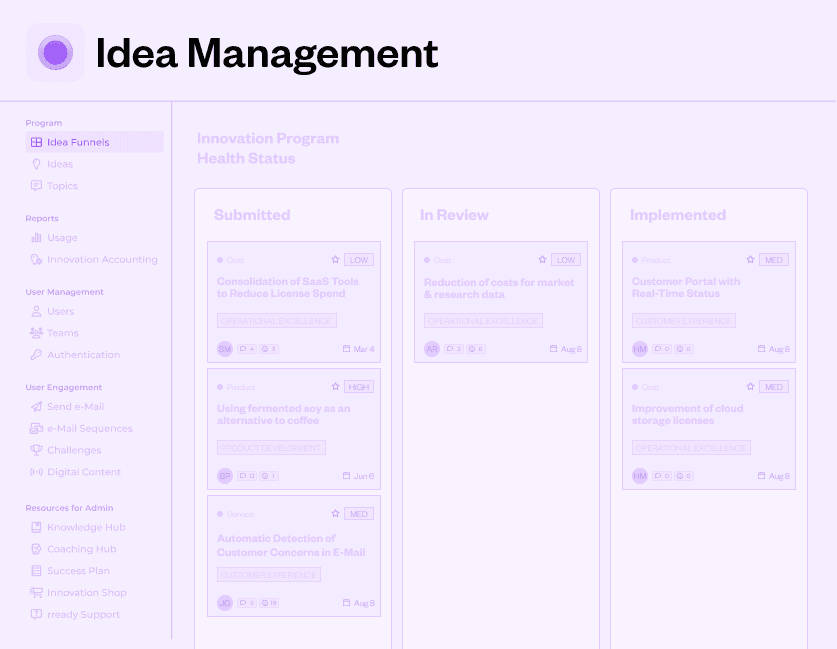
What is in clarification, what is under review, what is in implementation - and why?
Impact review
Each month: 3 numbers and 3 short stories. What was the problem? What was changed? What value contribution was achieved against which strategic objective?
Recognize contribution visibly
Idea contributors can and should be invited regularly by top management. A short presentation of what was achieved, a clear thank-you from the CEO, and an informal close with an apéro and meaningful conversation can have an outsized effect.
When these principles are applied consistently, idea management moves beyond the traditional suggestion box. It becomes an operational learning system. Innovation and continuous improvement stop feeling like extra work and start becoming a source of relief and renewal.
Final thought: It starts with a capacity decision
Most companies want more and better ideas. Truly successful companies create the conditions in which ideas can flow and generate tangible impact.
For that reason, the shift from idea push to idea pull is not primarily a matter of tools or communication. It is a leadership decision:
We will allocate reliable capacity to improvement and renewal, and we will actively manage the bottleneck that determines the flow of value.
When that happens, two things emerge that cannot be bought: credibility and energy.
And suddenly, idea management does not just make sense - it becomes genuinely effective and rewarding.
About the author
André Wermelinger supports organizations in improving value streams, making bottlenecks visible, and implementing innovation effectively. His work is grounded in many years of experience in project management, Lean management, Kanban, and organizational development, combined with a strong systems-thinking and evidence-based perspective on organizations as living systems.
Through ACW Consulting, he helps organizations achieve sustainable impact - not through activity for its own sake, but through focused, measurable, and continuous improvement.