European Jira & Confluence Alternatives (2026)
6 European alternatives to Jira and Confluence for 2026, ranked and compared on sovereignty, AI, migration tooling, and real pricing.


Atlassian has more than 120,000 customers across Europe, the Middle East, and Africa. EMEA accounts for roughly 40% of the company's global revenue. For a large share of that base, Jira and Confluence are simply what "how do we track work and document it" has meant for the past decade.
What's changed is what it costs to stay. Atlassian stopped taking new Data Center subscriptions on March 30, 2026, existing Data Center customers can renew only until March 30, 2028, and the product goes fully end-of-life on March 28, 2029, with no first-party path to migrate a Data Center instance to anything other than Atlassian Cloud.
Cloud itself isn't standing still either: Atlassian raised Jira and Confluence Cloud list prices 5 to 10 percent effective October 15, 2025 (Standard +5%, Premium +7.5%, Enterprise +7.5–10%). And Cloud pins customer data to AWS regions under a company that remains subject to the US CLOUD Act regardless of where the servers sit, which is exactly the exposure driving European buyers to look elsewhere.
Most existing roundups of these options are directories, not evaluations: 8 to 22 names ranked by a GDPR badge, with no attempt to test any of them against the criteria that actually decide a procurement outcome. This piece does that testing directly, against six platforms that are built to replace Jira and Confluence.
Key takeaways
"European alternative" describes a market position, not a capability set
EU hosting and GDPR language are table stakes across nearly every platform on this list. The real differences show up in AI governance, migration tooling, and whether a platform covers both ticketing and documentation natively or needs a partner to do it.
Only sovara natively spans both ticketing and a full wiki at parity
OpenProject, YouTrack, and easy8 are all work-management-first with a lighter wiki bolted on: OpenProject's and YouTrack's wikis are project-scoped rather than standalone knowledge bases. easy8's MediaWiki-based wiki sits behind its ticketing as the secondary half.
XWiki and Phonemos sit on the other side of the same gap, wiki-only with no native agile boards; XWiki pairs with OpenProject for that layer through a paid Enterprise add-on OpenProject shipped in v17.6 (July 2026), which cross-links work packages to a separate XWiki instance rather than merging the two into one platform, and Phonemos integrates with external Jira or YouTrack instances instead of replacing them outright.
AI support splits the field into three tiers
Several platforms have AI in beta or on a near-term roadmap, each with a different data-handling posture. easy8 gates its AI assistants by pricing tier. Only sovara pairs full sovereignty with production AI and a bring-your-own-LLM option, configured per feature rather than defaulted by the vendor.
Migration tooling is uneven even among the strongest contenders
OpenProject's official Jira Migrator has shipped and improved steadily since v17.4 (May 2026), but as of its latest release it still only imports from Jira Server and Data Center, not Cloud, and there's still no Confluence importer. That's worth knowing before assuming "open source" means "easy to move your data into."
Real pricing ranges from under €2 to over €25 per user, per month
Most of these platforms charge per seat, which means the total changes with headcount. sovara is the outlier: a company-wide license, independent of user count, which changes the math entirely for organizations with a large external or contractor user base.
sovara is the only platform on this list rated fully on both sovereignty and AI at once
Every other option trades one for the other: full AI with no sovereign path, or full sovereignty with AI still in beta or gated by tier.
How we compared these alternatives
Each platform was evaluated across the same six criteria:
Deployment model and data sovereignty
AI governance (does it support bring-your-own-model, and can it be disabled)
Native coverage of both ticketing and knowledge management
Migration tooling and lock-in
Security certifications held at the product level (not just the hosting layer),
Pricing
The ranking below weighs sovereignty-as-default and full-stack coverage most heavily, since those are the two things a listicle badge doesn't verify and a buyer usually finds out about only after signing. Where we could verify a claim against a public source (a pricing page, a G2 listing, a vendor's own documentation), we cited it. Where we couldn't, we said so rather than guessing.
This piece is deliberately the entry point: one comparison across all six platforms at once. For a deeper, capability-by-capability breakdown against any single one of them, each alternative below links to its own detailed comparison page.

1. sovara
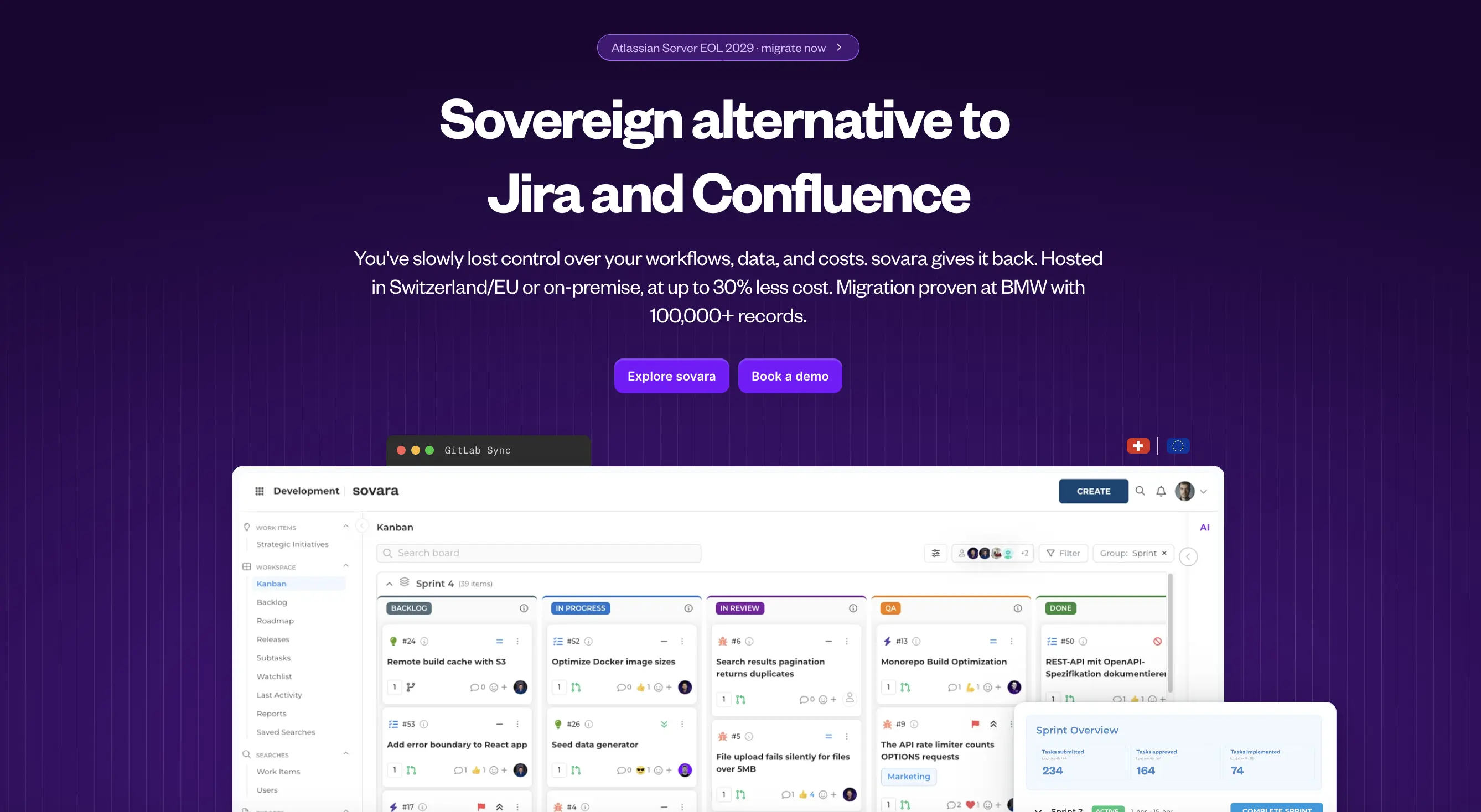
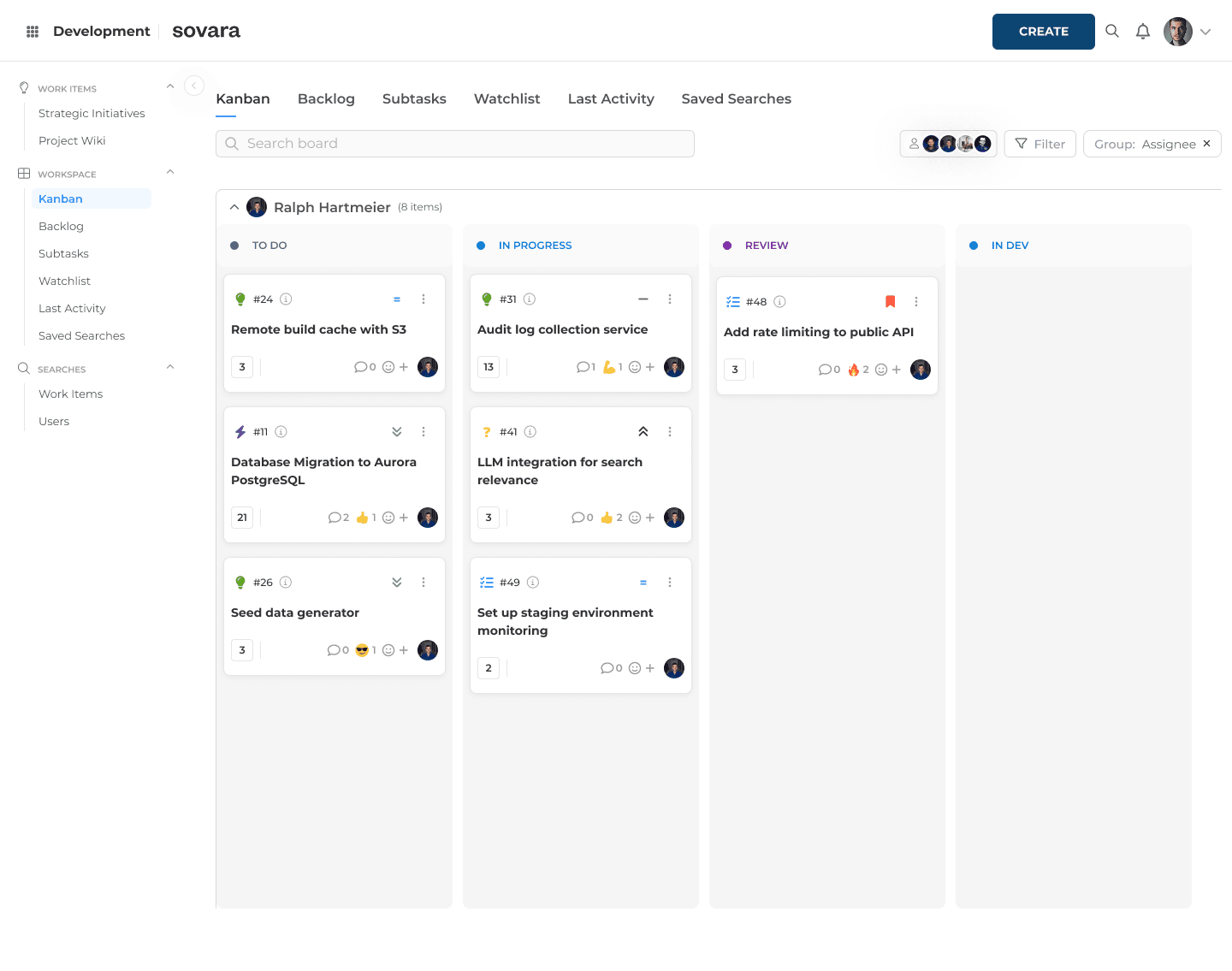
sovara is rready's sovereign alternative to Jira and Confluence: one data model, one admin console, and one license covering both ticketing and knowledge management, built by a company with no US corporate parent.
Standout features:
Deploys as SaaS, private cloud, or full on-premises (Docker/Kubernetes), the customer picks the model; cloud-agnostic across AWS, Google Cloud, Swisscom Cloud, Abraxas, and now STACKIT/IONOS, with EU and sovereign infrastructure available across all three deployment models, not just on-prem, and data residency contractually fixed to the EU or Switzerland regardless of which provider is chosen
Native AI agents for drafting, summaries, and reporting, configured per feature against whichever endpoint a customer chooses (self-hosted model, their own OpenAI-compatible key, or none at all)
ISO/IEC 27001:2022 certified and BSI C5 attested at the product level
Migration guarantee on standard Jira configurations (tickets, workflows, automations, core setup), refunded if it doesn't deliver
Exit guarantee: full workspace export via REST or CLI in open formats (Markdown, JSON), with source code held in escrow with an independent third party
Where it's still catching up:
Live co-editing is on the roadmap, not yet shipped
No app marketplace comparable to Atlassian's; integrations run through native connectors, REST, and MCP instead
The migration guarantee's "standard configuration" excludes Marketplace apps, custom code, deeply nested permission schemes across business units, and SSO/SCIM provisioning tied to an existing identity provider, all of which get scoped and quoted separately rather than assumed to transfer automatically
Pricing: Company-wide, independent of user count, covering internal and external users under one agreement rather than a per-seat model.
Compare sovara vs. Jira in detail here.
2. OpenProject

OpenProject is Germany's answer to Jira: GPLv3 open-source, EU-headquartered, with an EU-hosted Enterprise Cloud. It's the platform most likely to show up when "European" and "open source" both matter to a buyer, and the OpenProject vs Jira comparison is close enough on core project management that the deciding factor is usually migration tooling, not features.
Standout features:
Work-package hierarchy, Gantt timeline, portfolio views, time tracking, and cost reporting, all native
Full data ownership with no vendor lock-in: self-host on-prem via Docker, Kubernetes, or DEB/RPM packages, or use the EU-hosted cloud edition
Real-time co-editing with live cursors in its Documents module (v17.0+)
An MCP server (v17.2+) that enables external LLMs with a privacy-first design
Where it falls short:
Its official Jira Migrator shipped in v17.4 (May 2026) and gained more field coverage in 17.5 and 17.6, but it's still beta, covers Jira Server and Data Center only (not Cloud), and there's still no Confluence importer
No product-level ISO 27001, SOC 2, or BSI C5 certification
No mature native AI authoring yet; the MCP server enables external LLMs but doesn't replace an in-app assistant
Its native wiki is project-scoped, not the standalone knowledge base Confluence replaced; OpenProject's answer is a paid Enterprise add-on (shipped in v17.6, July 2026) that cross-links work packages to a separate XWiki instance, not a built-in standalone knowledge base, so you're still running and administering two systems
Pricing: Cloud plans start around €5.95 per user, per month for the Basic tier, scaling to roughly €15.95 for Premium, with a 25-user minimum. Self-hosted Community edition is free; Enterprise on-premises adds a per-user license fee for support and advanced features.
See the detailed sovara vs. OpenProject comparison for the full capability-by-capability breakdown.
3. easy8
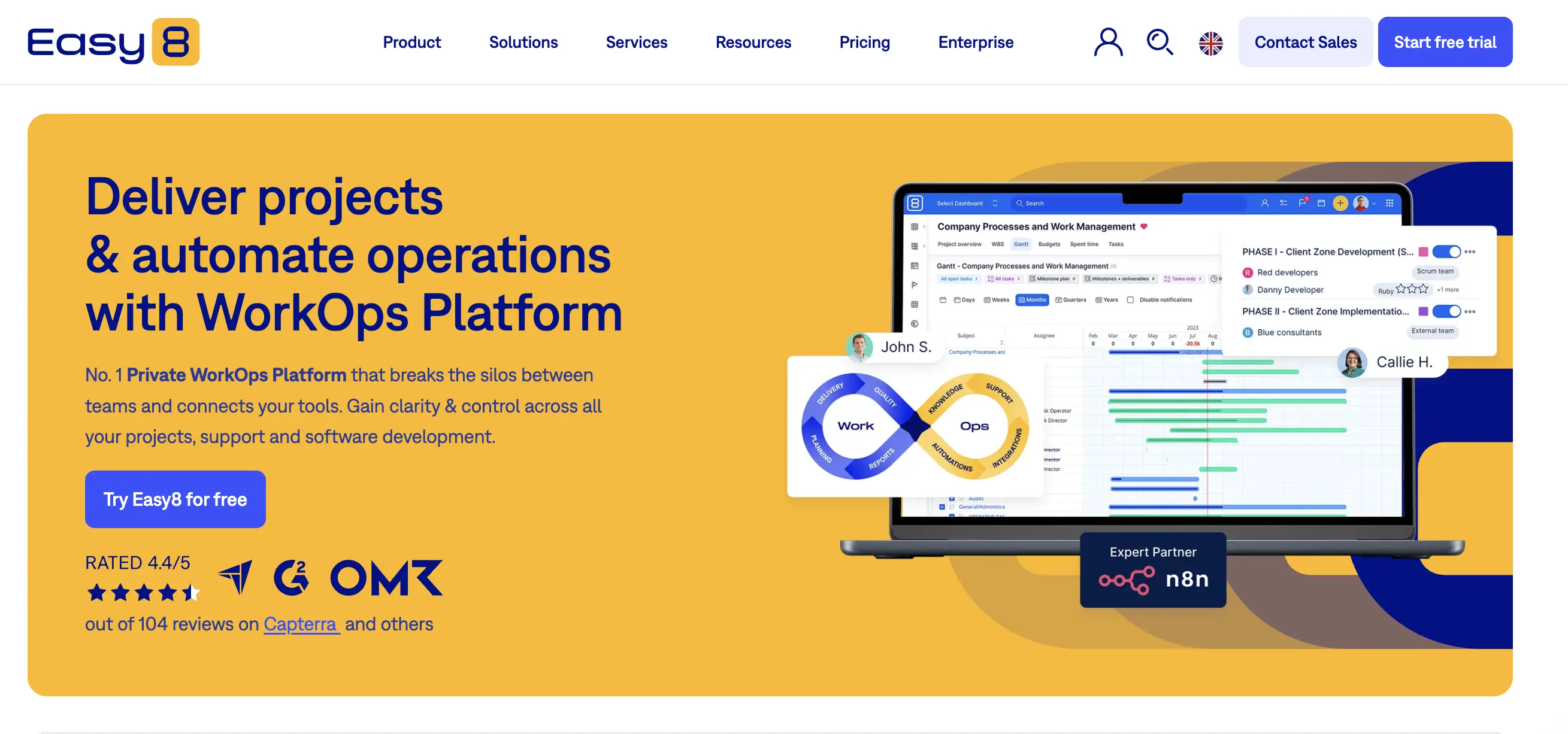
easy8 (built by Easy Software in Prague) positions itself as a full Atlassian-stack replacement: tickets, wiki, agile boards, and native AI assistants in one product, with an EU Sovereign Cloud option alongside its global cloud.
Standout features:
Full native coverage: Scrum/Kanban boards, backlog, Gantt and Global Gantt, resource management, project cost and budget tracking, and a MediaWiki-based wiki
"Easy AI" assistants for helpdesk, knowledge base, and project planning, built in natively
ISO 27001, 27017, 9001, and 42001 (the AI-management-system standard) certifications
Native Jira import tool, plus a 1,000-plus prebuilt connector catalogue through its n8n partnership
Where it falls short:
Its public cloud also runs US and Canada regions; sovereignty is a configurable option on the EU Sovereign Cloud tier, not the default
No SOC 2 or BSI C5 certification, and SCIM and audit-log support are unverified
Per-seat pricing with a 10-user cloud (25-user on-prem) minimum means cost scales directly with headcount, including external users
Pricing: Essentials at €6.90, Business at €13.90, and Platform at €25.90 per user, per month, with wiki, asset management, and CRM modules priced as separate add-ons.
See the detailed sovara vs. easy8 comparison for the full capability-by-capability breakdown.
4. YouTrack

YouTrack is JetBrains' issue tracker, a natural fit for teams already using IntelliJ, TeamCity, or other JetBrains tools, with a Frankfurt data center added in February 2026 for EU-resident customers.
Standout features:
A JavaScript-based workflow engine with guard, action, and requirement rules, plus no-code and scripting options for automation
Native Jira and Confluence import for both cloud and self-hosted source instances, with full database export and a bidirectional cloud-to-server migration path, some of the strongest migration tooling on this list
Full-text search plus a JQL-like query language, saved searches, and built-in reports (burndown, flow, distribution)
Both cloud (AWS) and self-hosted deployment options
Where it falls short:
Real-time concurrent co-editing isn't released yet; it's a roadmap item
Its AI Assistant is cloud-routed through OpenAI or Google with no bring-your-own-key option
Portfolio, resource, and budget planning are comparatively weak next to dedicated PMO tools
No confirmed BSI C5 attestation, and SOC 2 coverage (2023.2) is the extent of its independent certification
Pricing: Free for teams up to 10 users. Above that, roughly €4.50 to €5.40 per user, per month depending on monthly versus annual billing, with the effective rate decreasing as team size grows.
See the detailed sovara vs. YouTrack comparison for the full capability-by-capability breakdown.
5. XWiki
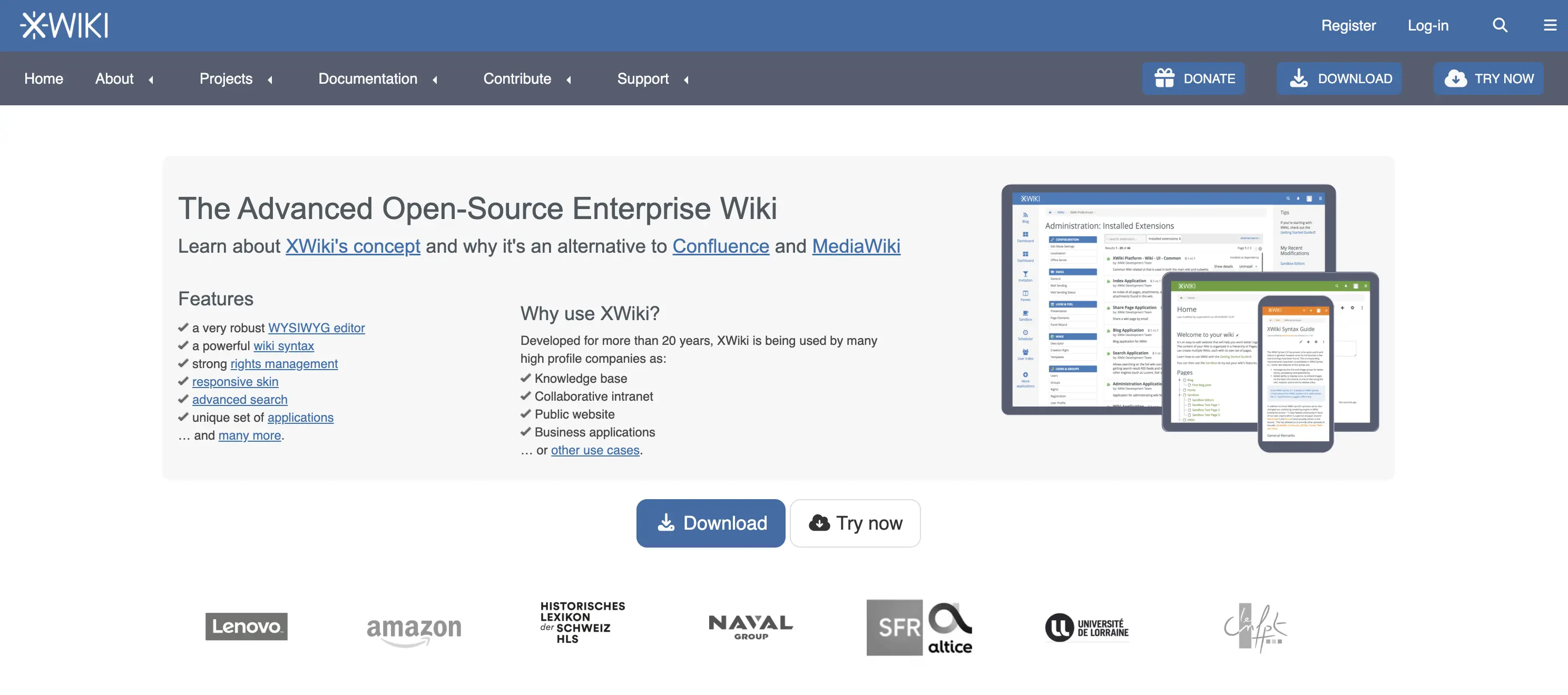
XWiki is an open-source wiki platform (LGPL) with a genuinely mature editor: live co-editing is on by default, not a roadmap promise, and its extension ecosystem runs past 900 add-ons.
Standout features:
CKEditor-based WYSIWYG with real-time concurrent co-editing, inline and threaded comments, and version history with diff, all default-on
900-plus extensions and an "App Within Minutes" builder for lightweight custom applications without writing code
A dedicated Confluence Migrator (free and Pro tiers) plus exports to open formats (XAR, PDF, ODT, HTML, XML), which keeps lock-in low
Self-host on-prem, or use XWiki Cloud, hosted on OVHcloud in France
Where it falls short:
No native agile boards, sprints, or backlog at all; OpenProject's Enterprise add-on (shipped v17.6, July 2026) can cross-link XWiki pages to OpenProject work packages, but that's an integration between two separate systems, not agile functionality built into XWiki itself
Its official AI assistant is still in beta (launched October 2024), with bring-your-own-LLM support but limited maturity for autonomous agents
ISO 27001 covers the hosting layer only, not the product itself, and there's no SCIM support
Pricing: Cloud tiers run roughly €1.74 to €2.94 per user, per month depending on plan. The core software, its extensions, and the open-source community edition are free under LGPL.
See the detailed sovara vs. XWiki comparison for the full capability-by-capability breakdown.
6. Phonemos

Phonemos is a Swiss-operated platform built around AI semantic search, with full on-prem deployment available alongside its Swiss/EU-hosted cloud (linkyard Cloud), outside CLOUD Act reach.
Standout features:
AI semantic search across spaces, hierarchical page trees, and metadata tables, its headline strength
Native MCP server for agent access, plus DeepL translation built in
Swiss-operated infrastructure with 2FA and FIDO2 support
Confluence (both Data Center and Cloud), Jira Data Center, SharePoint, and Azure DevOps migration importers, plus open export formats
Where it falls short:
No epic hierarchy, sprint, or backlog structure; its Kanban board is still listed as under development, so it integrates with an external Jira or YouTrack instance rather than replacing agile tooling outright
Workflows are listed as "coming soon," with no mature no-code rule builder yet
No webhooks and no plugin marketplace, and its reporting is comparatively weak (no JQL-style queries, no custom charts)
SCIM, SOC 2, and BSI C5 status are all unverified in public documentation
Pricing: User-based pricing combined with a monthly base fee: Team costs 3 CHF per editor plus a 50 CHF base fee; Business costs 5 CHF per editor plus a 100 CHF base fee. Viewers pay 1 CHF per month. Enterprise is priced on a custom basis and is the only option for on-premises deployment, custom contracts, and integrations.
See the detailed sovara vs. Phonemos comparison for the full capability-by-capability breakdown.
What's the best European alternative to Jira and Confluence?
It depends on what's actually breaking. A team that mainly needs a sovereign wiki, and already has a project tool it likes, might genuinely be better served pairing XWiki with OpenProject than switching everything at once, though that still means running two systems: two vendors, two SSO configurations, and two places for permissions to drift out of sync.
A team with strong in-house DevOps and JetBrains tooling already in place might find YouTrack's migration path and scripting the easiest lift.
A team that wants native AI without giving up sovereignty, replacing both Jira and Confluence in one product, has fewer real options, and that's the gap sovara was built to close.
sovara: the most complete alternative to Jira and Confluence
sovara doesn't ask a buyer to choose between sovereignty and AI, or between ticketing and knowledge management. rready AG is incorporated in Zurich, verifiable in the Swiss commercial register, with no US corporate parent in its ownership chain.
Data residency is contractually fixed to the EU or Switzerland no matter which cloud-agnostic provider a deployment runs on, AI is configured per feature against a customer-chosen endpoint rather than a vendor default, and both work tracking and documentation run on one data model, one admin console, and one license.
For anyone who wants to check these claims against their own requirements rather than take a vendor's word for it, rready ran sovara against Atlassian's own public RFI/RFP questionnaires for Jira and Confluence, item by item: 207 of 271 combined requirements met, including 89% of the capabilities Atlassian itself discontinued moving from Server to Cloud.
For the full, capability-by-capability version of that comparison, see sovara vs. Jira & Confluence.
FAQ
Are European alternatives to Jira and Confluence GDPR compliant by default?
Most claim GDPR alignment, but compliance depends on more than hosting location. Check where the vendor's corporate parent is domiciled (CLOUD Act exposure follows the company, not the server), whether AI features route data outside the EU, and whether certifications apply to the specific deployment mode you'd use.
What happens to Jira Data Center after 2029?
Jira Data Center's end of life is already on the calendar: Atlassian stopped new subscriptions on March 30, 2026, existing customers can renew until March 30, 2028, and support, downloads, and renewals stop entirely on March 28, 2029, after which the product moves to read-only mode.
Can I self-host a European alternative to Jira and Confluence?
Several can. OpenProject and XWiki are both open-source with on-premises deployment options, easy8 offers on-prem Docker deployment, and sovara supports full on-premises deployment alongside private cloud and SaaS. Jira Cloud has no self-hosted option; Jira Data Center is self-hosted but losing support in 2029.
Do European Jira alternatives support AI the way Atlassian's Rovo does?
Not equally. Most are in beta or roadmap stage for native AI authoring. The more relevant question for a sovereignty-focused buyer isn't AI maturity alone, it's whether the AI option includes bring-your-own-model support and can be fully disabled, which several alternatives, including Jira Cloud's Rovo, don't offer.

Read more

Shadow AI in approved software: what Atlassian Rovo shows
What exactly is shadow AI? Often an update to software you approved years ago. Using Jira Rovo as the example: what to check for your AI governance.

Atlassian Data Center End of Life: Migrate, stay or leave
Atlassian Data Center EOL lands March 28, 2029. See the verified timeline, what's in scope, the licensing math, and the three destinations now open to you.
European Jira & Confluence Alternatives (2026)
6 European alternatives to Jira and Confluence for 2026, ranked and compared on sovereignty, AI, migration tooling, and real pricing.